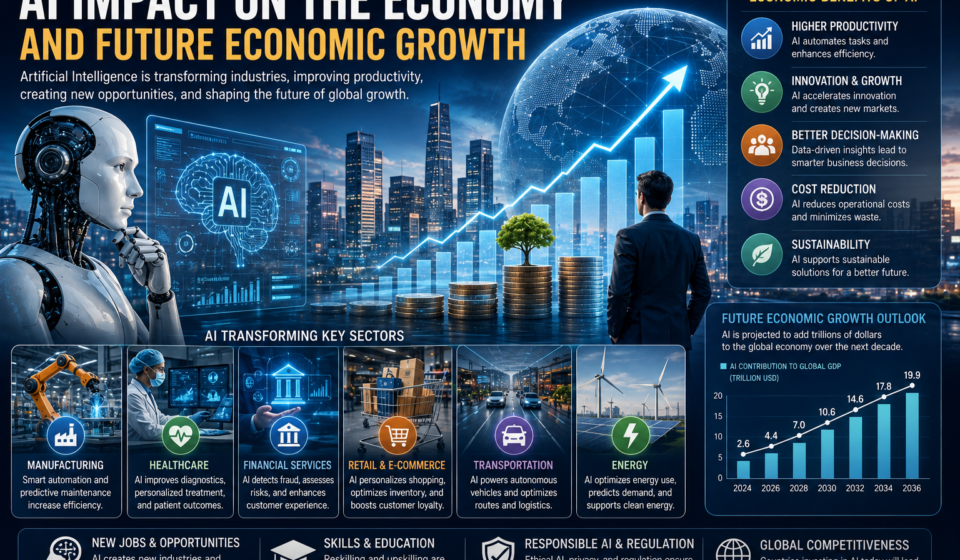

AI Impact on the Economy and Future Economic Growth – Artificial intelligence has become one of the most transformative technologies of the modern era. In 2026, discussions about the AI Impact on the Economy are no longer limited to technology companies and research institutions. Governments, businesses, investors, and workers are all paying close attention to how artificial intelligence is changing productivity, employment, innovation, and economic growth.
The rapid adoption of AI tools across industries is reshaping the global economy at an unprecedented pace. From automating routine tasks to improving decision-making and accelerating scientific discovery, AI is creating new opportunities while also introducing new challenges. As economies become increasingly digital, understanding the AI Impact on the Economy is essential for anyone seeking to navigate the future of business and investment.
Understanding AI’s Role in Economic Transformation
Artificial intelligence refers to computer systems capable of performing tasks that traditionally require human intelligence. These tasks include learning from data, recognizing patterns, understanding language, solving problems, and making predictions.
Recent advances in machine learning, generative AI, cloud computing, and data analytics have significantly expanded the capabilities of AI systems. Businesses can now process vast amounts of information faster and more accurately than ever before.
The growing AI Impact on the Economy can be seen in nearly every major industry. Companies are using AI to improve efficiency, reduce costs, increase productivity, and develop innovative products and services that were previously impossible.
As adoption expands, AI is becoming a fundamental component of economic growth rather than simply a technological tool.
AI as a Driver of Productivity Growth
One of the most important aspects of the AI Impact on the Economy is its ability to boost productivity.
Productivity measures how efficiently goods and services are produced. Economists have long recognized productivity growth as one of the primary drivers of long-term economic expansion and rising living standards.
AI improves productivity by:
- Automating repetitive tasks
- Reducing human error
- Optimizing workflows
- Improving resource allocation
- Accelerating decision-making
- Enhancing operational efficiency
Employees can spend less time on routine administrative work and focus on higher-value activities that require creativity, critical thinking, and strategic planning.
As organizations continue integrating AI into daily operations, productivity gains are expected to contribute significantly to economic growth over the coming years.
Transforming Business Operations
The AI Impact on the Economy is particularly evident in how businesses operate.
Companies across sectors are using AI-powered systems to improve performance and competitiveness. AI applications can analyze customer behavior, forecast demand, optimize supply chains, detect fraud, and personalize marketing campaigns.
Businesses benefit from:
- Faster decision-making
- Better customer insights
- Improved inventory management
- Reduced operating costs
- Enhanced customer experiences
- Greater efficiency
Organizations that successfully implement AI often gain a competitive advantage over rivals that rely on traditional processes.
This widespread adoption is helping create a more efficient and data-driven economy.
AI and Economic Growth
Economic growth depends on several factors, including labor force expansion, capital investment, technological innovation, and productivity improvements.
The AI Impact on the Economy affects all of these drivers.
Increased Productivity
AI enables businesses to produce more output with existing resources.
Accelerated Innovation
Researchers and companies can use AI to solve problems more quickly and develop new products faster.
New Industries
AI is creating entirely new markets and business opportunities.
Improved Capital Efficiency
Organizations can allocate resources more effectively using AI-powered analytics.
Together, these benefits can support stronger economic growth and higher levels of prosperity.
Many economists believe artificial intelligence could become one of the most important growth engines of the twenty-first century.
The Impact on Employment
Employment remains one of the most debated aspects of the AI Impact on the Economy.
Artificial intelligence can automate certain tasks traditionally performed by humans. This raises concerns about job displacement in some occupations, particularly those involving repetitive and predictable activities.
Examples include:
- Data entry
- Administrative support
- Basic customer service
- Routine manufacturing processes
- Simple bookkeeping functions
However, technological innovation has historically created new jobs while eliminating others.
AI is generating demand for professionals in areas such as:
- Data science
- Machine learning
- Cybersecurity
- Software development
- Robotics
- Digital transformation
The long-term impact on employment will depend largely on how effectively workers adapt to changing skill requirements.
AI and the Future of Work
Rather than replacing workers entirely, AI is more likely to transform how people work.
Many professionals are already using AI tools to improve productivity and enhance decision-making.
Employees can leverage AI to:
- Generate content
- Analyze data
- Automate workflows
- Conduct research
- Improve communication
- Enhance customer support
This collaboration between humans and machines may become the dominant workplace model in the future.
The AI Impact on the Economy will increasingly involve augmentation rather than complete automation, allowing workers to focus on tasks that require creativity, leadership, emotional intelligence, and complex problem-solving.
Small Businesses and Entrepreneurship
Artificial intelligence is no longer accessible only to large corporations.
Cloud-based AI platforms and affordable software solutions have made advanced technology available to small and medium-sized businesses.
Entrepreneurs can use AI for:
- Marketing automation
- Customer relationship management
- Financial forecasting
- Inventory optimization
- Content creation
- Sales analysis
These capabilities help smaller firms compete more effectively and improve operational efficiency.
The democratization of AI technology may encourage innovation, entrepreneurship, and business formation across many sectors of the economy.
AI in Manufacturing
Manufacturing is among the industries experiencing the most significant AI-driven transformation.
Modern factories use artificial intelligence to:
- Monitor equipment performance
- Predict maintenance needs
- Improve quality control
- Optimize production schedules
- Reduce waste
- Increase efficiency
Combined with robotics and industrial automation, AI is helping manufacturers improve productivity while lowering operating costs.
This transformation strengthens competitiveness and supports economic growth by increasing industrial output.
AI in Healthcare
Healthcare is another sector where the AI Impact on the Economy is becoming increasingly significant.
Artificial intelligence supports healthcare providers through:
- Medical imaging analysis
- Predictive diagnostics
- Personalized treatment recommendations
- Drug discovery
- Administrative automation
These applications improve efficiency while helping healthcare systems manage growing demand.
As populations age and healthcare costs continue to rise, AI may play a crucial role in improving access to care while controlling expenses.
The economic benefits extend beyond healthcare providers to patients, insurers, and governments.
Financial Services and Economic Efficiency
The financial industry has embraced artificial intelligence at a rapid pace.
Financial institutions use AI for:
- Fraud detection
- Credit risk assessment
- Investment analysis
- Customer service automation
- Regulatory compliance
AI-powered tools help improve decision-making and reduce operational costs.
The AI Impact on the Economy in financial services includes increased efficiency, better risk management, and broader access to financial products.
These improvements support investment activity and contribute to overall economic development.
Global Competitiveness and National Growth
Countries around the world recognize the strategic importance of artificial intelligence.
Governments are investing heavily in:
- AI research
- Technology infrastructure
- Education and training
- Innovation ecosystems
- Digital transformation initiatives
Nations that successfully develop strong AI capabilities may experience faster productivity growth and enhanced global competitiveness.
The AI Impact on the Economy is increasingly influencing international competition as countries race to become leaders in artificial intelligence development and deployment.
Success in AI could shape future economic power and geopolitical influence.
AI and Investment Opportunities
Artificial intelligence has become one of the most important themes in global financial markets.
Investors are directing capital toward:
- Semiconductor manufacturers
- Cloud computing providers
- AI software companies
- Data infrastructure firms
- Robotics businesses
- Cybersecurity companies
Many organizations are expected to benefit from rising AI adoption and increasing demand for digital solutions.
The AI Impact on the Economy is creating new investment opportunities while also transforming traditional industries.
Investors who understand these trends may be better positioned to identify future growth sectors.
Challenges Associated with AI Adoption
Despite its enormous potential, artificial intelligence presents several challenges.
Workforce Disruption
Some jobs may become obsolete as automation expands.
Skills Shortages
Many industries face shortages of workers with advanced digital and technical skills.
Data Privacy
AI systems often require large amounts of data, raising privacy concerns.
Algorithmic Bias
Poorly designed AI systems can produce unfair outcomes.
Regulatory Uncertainty
Governments continue developing policies to govern AI deployment.
Addressing these challenges is essential for maximizing the benefits of AI while minimizing potential risks.
AI and Economic Inequality
The distribution of AI-driven gains remains an important issue.
If the benefits of artificial intelligence are concentrated among a small number of companies or individuals, economic inequality could increase.
Policymakers may need to focus on:
- Workforce retraining
- Educational investment
- Digital inclusion
- Skills development
- Economic mobility programs
Ensuring broad participation in AI-driven growth can help create a more inclusive economy.
The long-term success of artificial intelligence will depend partly on how widely its benefits are shared.
Sustainability and the AI Economy
Artificial intelligence can also support environmental sustainability.
Organizations are using AI to:
- Improve energy efficiency
- Optimize transportation networks
- Reduce waste
- Manage renewable energy systems
- Monitor environmental conditions
These applications help businesses reduce costs while supporting sustainability goals.
As governments and companies prioritize environmental responsibility, AI may become an increasingly important tool for building a more sustainable economy.
The Future of AI-Driven Economic Growth
Looking ahead, the AI Impact on the Economy is expected to expand significantly.
Several trends are likely to shape future growth:
- Greater automation
- More advanced AI systems
- Increased productivity gains
- Faster innovation cycles
- Expanded digital transformation
- Stronger human-AI collaboration
As adoption becomes more widespread, artificial intelligence may influence virtually every sector of economic activity.
The economies that successfully integrate AI while managing associated risks are likely to enjoy stronger long-term growth and competitiveness.
Conclusion
The AI Impact on the Economy is already transforming how businesses operate, how workers perform their jobs, and how countries compete in the global marketplace. Through increased productivity, enhanced innovation, improved decision-making, and the creation of new industries, artificial intelligence has the potential to become one of the most important drivers of economic growth in modern history.
At the same time, challenges related to employment, regulation, skills development, and inequality must be carefully managed. Policymakers, businesses, and educational institutions all have important roles to play in ensuring that AI-driven growth benefits society as a whole.
As artificial intelligence continues to evolve, its influence on economic performance will only increase. Understanding the AI Impact on the Economy will therefore remain essential for investors, businesses, workers, and governments seeking to succeed in the rapidly changing global economy.