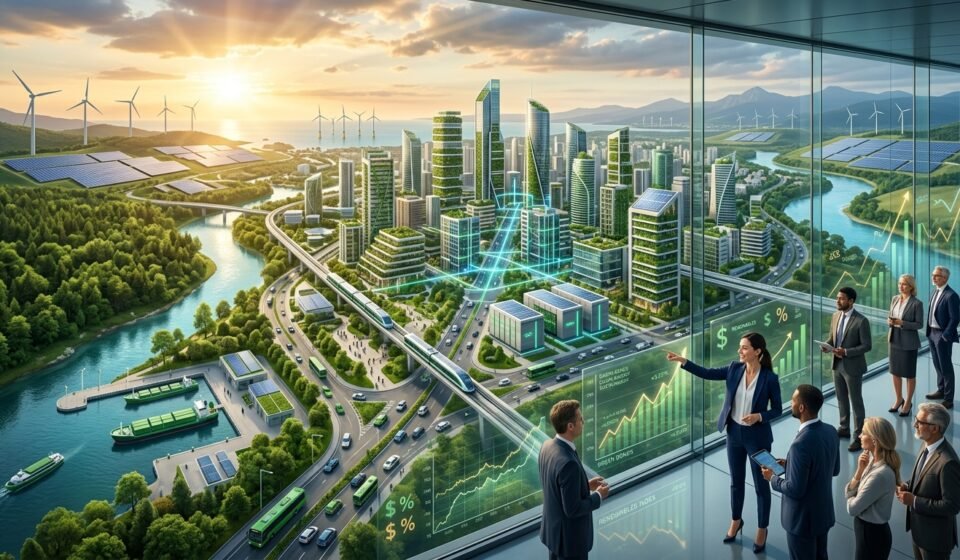

Green Economy Investments Driving Future Growth – The global economy is entering a period in which environmental sustainability and economic growth are becoming increasingly connected. Investments in renewable energy, clean technology, sustainable infrastructure, resource efficiency, and nature-positive businesses are no longer viewed solely as environmental initiatives. They are increasingly becoming strategic economic opportunities capable of creating jobs, improving energy security, supporting innovation, and generating long-term returns.
The green economy is expanding despite policy uncertainty, changing energy markets, and differences in government approaches. According to LSEG, the global green economy surpassed $10 trillion in 2026, demonstrating the growing scale of businesses and industries providing environmental solutions. At the same time, the International Energy Agency estimates that global energy investment will reach approximately $3.4 trillion in 2026, with clean energy receiving about $2.2 trillion, almost twice the amount directed toward fossil fuels.
These developments suggest that green economy investments are becoming an important engine of future economic growth. Understanding where capital is flowing and why these sectors are expanding can help investors, businesses, and policymakers identify the opportunities shaping the next decade.
What Is the Green Economy?
The green economy refers to economic activities that generate goods and services while reducing environmental damage, improving resource efficiency, or supporting sustainable development. It extends far beyond solar panels and wind turbines.
The sector includes renewable electricity, battery storage, electric vehicles, energy-efficient buildings, sustainable agriculture, recycling, clean water, green hydrogen, low-carbon manufacturing, sustainable transportation, and environmental technology.
It also includes financial products designed to support these activities, such as green bonds, sustainability-linked financing, transition finance, and climate-focused investment funds.
The increasing diversity of the green economy is important because it means investors are no longer limited to a small group of renewable energy companies. Opportunities now exist throughout multiple industries and supply chains.
Clean Energy Is Becoming a Major Investment Driver
Renewable energy remains one of the most important pillars of green economy investment. Solar, wind, geothermal, hydropower, and other clean energy technologies are attracting capital because countries need reliable electricity while reducing exposure to fuel price volatility and energy supply disruptions.
The IEA’s 2026 investment outlook shows the scale of this transformation. Clean energy investment is expected to reach approximately $2.2 trillion during 2026, compared with roughly half that amount for fossil fuels.
This does not mean fossil fuels will immediately disappear. Oil, natural gas, and other conventional energy sources remain important to the global economy. However, the direction of new capital investment increasingly reflects the expansion of electricity demand and the need for cleaner, more resilient energy systems.
Solar power is particularly important because costs have declined significantly over the long term and projects can be deployed at different scales. Wind power, meanwhile, continues to play a major role in utility-scale electricity generation.
Investors are also paying greater attention to supporting infrastructure. Electricity grids, transformers, batteries, transmission networks, and energy management systems are essential for integrating growing amounts of renewable electricity.
Battery Storage and Grid Infrastructure Create New Opportunities
One of the biggest challenges associated with renewable energy is intermittency. Solar generation depends on sunlight, while wind generation changes according to weather conditions. Battery storage can help address this problem by storing electricity when supply is abundant and releasing it when demand rises.
As renewable energy capacity grows, demand for large-scale energy storage is expected to increase.
Grid modernization is another major opportunity. Many electricity networks were designed decades ago and now face increasing pressure from renewable generation, electric vehicles, data centers, industrial electrification, and population growth.
This creates investment opportunities in transmission infrastructure, smart grids, transformers, power management software, and distributed energy systems.
The connection between technology and energy is particularly important in 2026. Rapid growth in artificial intelligence and data centers is increasing electricity demand, making reliable power infrastructure strategically important. Recent infrastructure investment announcements also demonstrate how capital is increasingly targeting energy systems alongside digital infrastructure.
Green Transportation Is Reshaping Industries
Transportation is another major area of green economy investment.
Electric vehicles have moved from being a niche technology toward becoming an important part of the global automotive industry. Investment is flowing not only into vehicle manufacturers but also into batteries, charging infrastructure, battery materials, software, and recycling.
Electric buses and commercial vehicles are also creating opportunities for cities and logistics companies seeking to reduce fuel costs and emissions.
The transition to electric transportation is creating an entirely different industrial ecosystem. Battery manufacturing requires lithium, nickel, graphite, and other materials. Charging networks require electrical infrastructure. Battery recycling can help recover valuable materials and reduce dependence on new mining.
This demonstrates an important characteristic of the green economy: investment opportunities often exist across the entire value chain rather than within a single product category.
Energy Efficiency Could Become a Major Growth Market
Green investment is not only about producing cleaner energy. Using energy more efficiently can also generate significant economic value.
Buildings consume large amounts of energy for heating, cooling, lighting, and other activities. Investments in insulation, efficient air-conditioning systems, smart building controls, LED lighting, heat pumps, and energy management software can reduce operating costs while lowering energy consumption.
Industrial companies are also investing in efficiency technologies because energy represents a significant operating expense.
For businesses, energy efficiency can therefore offer a practical financial benefit. Instead of relying entirely on environmental incentives, companies can invest in technologies that reduce expenses and improve competitiveness.
This makes energy efficiency particularly attractive during periods of high energy prices or uncertain supply conditions.
Sustainable Infrastructure Will Support Long-Term Growth
Infrastructure investment is another critical component of the green economy.
Cities around the world need transportation networks, water systems, waste management facilities, resilient buildings, and energy infrastructure capable of handling changing climate conditions and growing populations.
Investment in sustainable infrastructure can support economic growth in multiple ways. Construction projects create employment, improved infrastructure increases productivity, and more resilient systems can reduce the economic costs associated with extreme weather and resource shortages.
Water infrastructure is especially important. Water treatment, desalination, leak detection, efficient irrigation, and industrial water recycling are becoming increasingly valuable as water stress affects more regions.
The World Economic Forum identified more than 50 investible nature-positive opportunities across areas including precision agriculture, sustainable cement, battery recycling, and industrial water management. These opportunities could potentially generate substantial revenues and cost savings while addressing environmental challenges.
Sustainable Finance Is Expanding the Capital Pool
The green economy cannot grow without financing. As projects become larger and more complex, banks, institutional investors, governments, and private equity firms are increasingly involved in funding the transition.
Green bonds are one of the most recognizable instruments. Governments, banks, and corporations can issue green bonds to finance projects such as renewable energy, clean transportation, sustainable buildings, and water infrastructure.
Other forms of sustainable finance include sustainability-linked loans, transition bonds, climate funds, and blended finance.
The development of these financial instruments is important because many green projects require substantial upfront capital but can generate revenue over long periods.
However, sustainable finance also faces challenges. Investors need reliable information to determine whether projects genuinely deliver environmental benefits. Inconsistent definitions and concerns about greenwashing can make it difficult to compare investment opportunities.
As a result, transparency, credible sustainability reporting, and measurable environmental outcomes are becoming increasingly important.
Emerging Markets Could Offer Significant Opportunities
Green economy investment is not limited to developed economies.
Emerging markets have significant opportunities because many are experiencing rapid population growth, urbanization, and increasing energy demand. Building clean infrastructure from the beginning can allow these economies to avoid some of the inefficient systems developed economies are now trying to replace.
The OECD reports that renewable-energy greenfield foreign direct investment more than doubled between 2016 and 2025, reaching around $200 billion in 2025. It also found that renewable energy investment is increasingly distributed across emerging and developing economies rather than remaining concentrated in advanced markets.
Countries with abundant sunlight, wind resources, geothermal potential, critical minerals, or large agricultural sectors may have particularly strong opportunities.
However, investors must carefully evaluate regulatory stability, currency risks, infrastructure quality, political conditions, and access to financing.
Green Manufacturing Can Strengthen Competitiveness
The green economy is also changing manufacturing.
Companies are investing in low-carbon production processes, recyclable materials, energy-efficient machinery, and cleaner industrial technologies. Manufacturers that reduce energy consumption and waste can potentially lower costs while meeting changing customer expectations.
Industries such as steel, cement, chemicals, and mining face particularly difficult challenges because their production processes can be energy-intensive.
This has created demand for technologies such as green hydrogen, carbon management, electrification, alternative fuels, and low-carbon materials.
Green manufacturing could therefore become an important source of industrial innovation. Countries that develop strong domestic supply chains for clean technologies may gain competitive advantages in global trade.
Nature-Positive Investments Are Gaining Attention
Another emerging area is investment in natural capital.
Forests, wetlands, agricultural land, oceans, and biodiversity provide economic services that support industries and communities. Protecting these resources can therefore have economic value beyond environmental benefits.
Investment opportunities include sustainable agriculture, regenerative farming, forest restoration, sustainable fisheries, ecosystem management, and nature-based tourism.
Companies are also developing technologies that improve agricultural productivity while reducing water, fertilizer, and pesticide use.
Precision agriculture is a good example. Sensors, satellite imagery, artificial intelligence, and automated equipment can help farmers apply resources more efficiently.
These technologies demonstrate how digital innovation can support environmental objectives while improving economic productivity.
Green Jobs and Human Capital Will Drive Growth
Investment in the green economy also creates demand for workers with new skills.
Renewable energy projects require engineers, technicians, construction workers, project managers, and maintenance specialists. Electric transportation creates demand for battery experts, software developers, charging technicians, and electrical engineers.
Energy-efficient buildings require architects, electricians, installers, and energy auditors.
As these industries expand, education and workforce development will become increasingly important. Countries that invest in green skills can improve their ability to attract clean technology companies and participate in emerging supply chains.
The green transition therefore has implications for employment as well as investment.
Risks Investors Should Consider
Despite its potential, green economy investing is not risk-free.
Government policy can significantly influence renewable energy markets, subsidies, tax incentives, emissions regulations, and infrastructure development. Changes in political priorities can therefore affect project economics.
Interest rates are another consideration. Many renewable energy and infrastructure projects require significant upfront investment, making financing costs important.
Technology risk also exists. Rapid innovation can make existing technologies less competitive. Companies that appear attractive today may face stronger competition from new solutions tomorrow.
Supply chains present additional challenges. Critical minerals, manufacturing capacity, shipping, and geopolitical tensions can affect the cost and availability of clean technologies.
Investors should therefore evaluate individual companies and projects rather than assuming that every green asset will automatically produce strong returns.
The Future of Green Economy Investment
The long-term direction of green investment appears increasingly connected to broader economic priorities such as energy security, industrial competitiveness, technological innovation, and infrastructure modernization.
This is an important shift.
Green investment is increasingly being justified not only because it can reduce emissions but also because it can improve energy independence, create jobs, reduce operating costs, strengthen supply chains, and support economic resilience.
LSEG’s 2026 research describes the green economy as a more than $10 trillion opportunity, highlighting the expanding role of environmental solutions across markets and asset classes. Meanwhile, the OECD has found that global low-carbon energy investment has increasingly exceeded fossil fuel energy investment, with clean energy investment reaching about $2.1 trillion in 2025.
These trends suggest that the green economy should increasingly be viewed as a structural component of global economic development rather than a temporary investment theme.
Conclusion
Green economy investments are helping reshape the foundations of future economic growth. Renewable energy, battery storage, electric transportation, energy efficiency, sustainable infrastructure, clean manufacturing, water technology, and nature-positive businesses are creating new markets and attracting substantial capital.
The opportunity is broad, but successful investment will require careful analysis. Companies need strong business models, projects need reliable economics, and investors need to distinguish genuine long-term opportunities from short-lived trends.
The transition will also vary between countries and industries. Some markets will move rapidly toward clean technologies, while others will continue relying on conventional energy sources for longer periods.
Nevertheless, the overall investment direction is becoming clearer. Capital is increasingly flowing toward technologies and infrastructure designed to address energy, environmental, and resource challenges.
As economies become more dependent on reliable electricity, efficient infrastructure, resilient supply chains, and innovative technologies, green investment could become one of the defining drivers of global growth over the coming decade. The green economy is therefore not simply about building a more sustainable future—it is increasingly about building the economic infrastructure needed to compete in it.