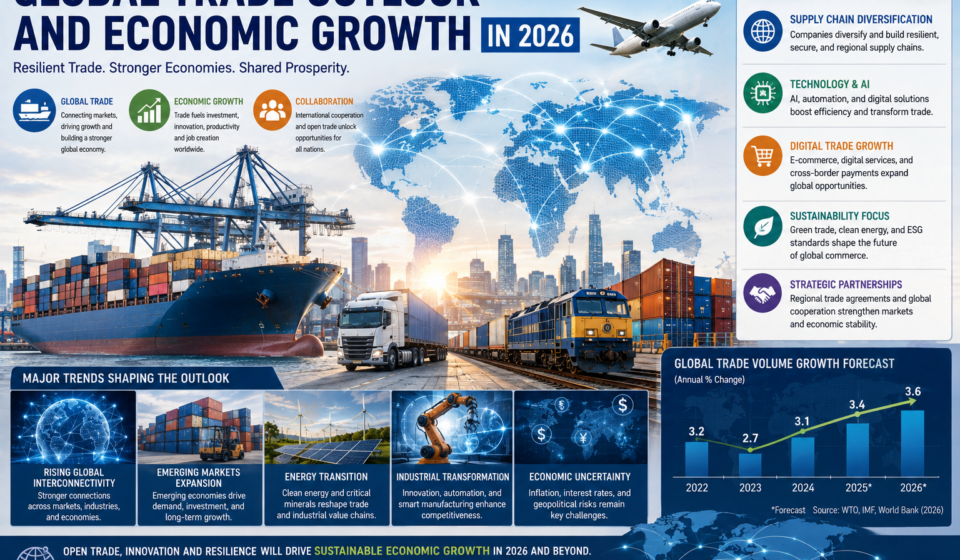

Global Trade Outlook and Economic Growth in 2026 – Global trade remains one of the most important drivers of economic growth, investment, and prosperity. In 2026, international commerce continues to play a critical role in connecting economies, supporting industries, and facilitating the flow of goods, services, capital, and technology across borders. However, the global trade environment is evolving rapidly as businesses and governments adapt to geopolitical tensions, technological transformation, supply chain restructuring, and changing consumer demands.
While global trade has demonstrated remarkable resilience in recent years, significant challenges remain. Trade disputes, rising tariffs, economic nationalism, regional conflicts, and concerns about supply chain security are reshaping traditional trade patterns. At the same time, emerging technologies, digital commerce, and expanding markets in developing economies are creating new opportunities for growth.
Understanding the Global Trade Outlook is essential for businesses, investors, and policymakers seeking to navigate an increasingly interconnected and complex economic landscape.
The Importance of Global Trade
Global trade enables countries to specialize in the production of goods and services where they hold competitive advantages. Through international commerce, nations can access resources, technologies, products, and markets that may not be available domestically.
The benefits of trade include:
- Higher economic growth
- Increased productivity
- Greater consumer choice
- Lower production costs
- Improved innovation
- Job creation
- Enhanced competitiveness
International trade also promotes economic integration and cooperation among countries, supporting long-term development and prosperity.
As economies become more interconnected, the performance of global trade increasingly influences overall economic growth.
Economic Growth and Trade Are Closely Connected
The relationship between trade and economic growth is mutually reinforcing.
Growing economies typically import more goods and services while also increasing exports. Meanwhile, expanding trade creates new markets for businesses, encourages investment, and stimulates production.
Trade contributes to economic growth by:
- Expanding market access
- Increasing efficiency
- Supporting innovation
- Encouraging competition
- Attracting foreign investment
Countries with strong export sectors often benefit from increased industrial activity, higher employment, and improved productivity.
In 2026, global economic growth continues to depend heavily on the health of international trade networks.
A More Complex Global Trade Environment
The Global Trade Outlook in 2026 reflects a more complex environment than in previous decades.
Businesses now face challenges that include:
- Geopolitical tensions
- Trade restrictions
- Supply chain disruptions
- Currency volatility
- Regulatory changes
- Energy market uncertainty
The era of trade driven primarily by efficiency and cost reduction is giving way to a model that also emphasizes resilience, security, and diversification.
Companies are increasingly evaluating risks alongside traditional considerations such as production costs and market access.
This shift is influencing investment decisions and reshaping global commerce.
The Impact of Geopolitical Tensions
Geopolitical developments have become major drivers of trade policy.
Competition among major economies, particularly between the United States and China, continues to influence trade flows, technology transfers, and investment strategies.
Governments are increasingly focusing on:
- Economic security
- Strategic industries
- Technology leadership
- Supply chain resilience
- Domestic manufacturing capacity
As a result, businesses must navigate a more fragmented global trading system.
While globalization remains important, geopolitical considerations are playing a larger role in determining trade relationships and investment decisions.
Supply Chain Diversification Continues
One of the most significant trends shaping the Global Trade Outlook is supply chain diversification.
Many companies are reducing dependence on single-country sourcing strategies and expanding production across multiple regions.
Popular approaches include:
- Nearshoring
- Friend-shoring
- Regional manufacturing
- Multi-country sourcing
These strategies help businesses reduce risks associated with:
- Political instability
- Trade restrictions
- Natural disasters
- Transportation disruptions
Countries such as India, Vietnam, Indonesia, Mexico, and several Eastern European economies are benefiting from increased investment as companies diversify their supply chains.
This trend is reshaping trade routes and creating new economic opportunities.
Technology Is Transforming Global Trade
Technology continues to revolutionize international commerce.
Digital tools are improving efficiency throughout global trade networks.
Key technologies include:
- Artificial intelligence
- Cloud computing
- Blockchain
- Internet of Things (IoT)
- Advanced analytics
- Automation
These technologies help businesses:
- Track shipments in real time
- Improve demand forecasting
- Reduce costs
- Increase transparency
- Enhance operational efficiency
Digital transformation is making trade faster, more predictable, and more resilient.
Companies that embrace technological innovation are often better positioned to compete in global markets.
The Rise of Digital Trade
Digital trade has become one of the fastest-growing segments of international commerce.
Businesses increasingly deliver products and services through digital channels, including:
- Software
- Streaming services
- Online education
- Cloud solutions
- Financial technology platforms
- Digital consulting services
Cross-border e-commerce continues expanding as consumers gain easier access to international products and brands.
The growth of digital trade is reducing barriers to entry and creating opportunities for businesses of all sizes to participate in global markets.
As internet access and digital infrastructure improve worldwide, digital trade is expected to become an even larger contributor to economic growth.
Emerging Markets Drive Growth
Emerging economies are becoming increasingly important contributors to global trade.
Many developing countries are experiencing:
- Rising incomes
- Expanding middle classes
- Infrastructure development
- Industrial growth
- Increased foreign investment
These factors support both domestic consumption and export expansion.
Countries across Asia, Latin America, Africa, and parts of the Middle East are strengthening their roles within global trade networks.
For multinational companies, emerging markets offer opportunities for:
- New customers
- Manufacturing expansion
- Resource development
- Strategic partnerships
The continued growth of emerging economies is expected to remain a major driver of global trade activity.
Trade and Inflation
Trade plays a significant role in influencing inflation.
Efficient global supply chains can help reduce costs and keep consumer prices stable. Conversely, trade disruptions may contribute to inflationary pressures by increasing production and transportation expenses.
Factors affecting trade-related inflation include:
- Shipping costs
- Energy prices
- Tariffs
- Supply shortages
- Currency fluctuations
In recent years, businesses and policymakers have become more aware of the connection between trade networks and price stability.
The ability to maintain efficient international trade flows remains important for controlling inflation and supporting economic growth.
Energy Markets and Global Trade
Energy remains a critical component of international commerce.
Oil, natural gas, renewable energy technologies, and critical minerals all influence global trade patterns.
Energy prices affect:
- Manufacturing costs
- Transportation expenses
- Consumer spending
- Industrial production
The transition toward cleaner energy systems is creating new trade opportunities in sectors such as:
- Electric vehicles
- Battery technology
- Renewable energy equipment
- Critical minerals
As countries invest in energy security and sustainability, energy-related trade is expected to remain a major area of growth.
Sustainability and Trade
Sustainability is becoming an increasingly important factor in international commerce.
Governments, investors, and consumers are demanding greater environmental responsibility from businesses.
Companies are responding by focusing on:
- Carbon reduction
- Sustainable sourcing
- Circular economy practices
- Energy efficiency
- Responsible supply chains
Environmental regulations are influencing trade decisions and investment strategies.
Businesses that successfully align sustainability goals with trade operations may gain competitive advantages in global markets.
Artificial Intelligence and Trade Efficiency
Artificial intelligence is helping improve the efficiency of global trade networks.
AI-powered systems can:
- Predict demand
- Optimize logistics
- Improve inventory management
- Monitor supply chain risks
- Enhance customs processing
These capabilities reduce costs and improve reliability.
The integration of AI into trade operations supports productivity growth and helps businesses adapt to changing market conditions.
As AI technology advances, its influence on international commerce is expected to increase significantly.
Regional Trade Agreements Continue to Expand
Regional trade agreements remain important drivers of economic integration.
Such agreements help reduce trade barriers and facilitate investment between participating countries.
Benefits include:
- Lower tariffs
- Simplified customs procedures
- Increased market access
- Improved regulatory cooperation
Regional partnerships are becoming increasingly important as businesses seek stable and predictable trading environments.
These agreements support economic growth by encouraging cross-border commerce and investment.
Challenges Facing Global Trade
Despite numerous opportunities, several challenges continue to affect the Global Trade Outlook.
Geopolitical Risks
International conflicts and political tensions can disrupt trade flows.
Protectionism
Tariffs and trade barriers may reduce market access.
Supply Chain Vulnerabilities
Unexpected disruptions can affect production and distribution.
Economic Uncertainty
Slower growth may reduce demand for goods and services.
Climate Risks
Extreme weather events can impact transportation and production infrastructure.
Businesses must remain flexible and proactive to manage these evolving risks.
What Investors Should Watch
Investors monitoring global trade trends should pay attention to:
- Trade policy developments
- Economic growth forecasts
- Supply chain investments
- Technology adoption
- Energy market trends
- Emerging market performance
- Geopolitical developments
These factors can significantly influence corporate earnings, investment opportunities, and market performance.
Understanding trade dynamics helps investors identify sectors and regions with strong growth potential.
The Future of Global Trade
Looking ahead, the Global Trade Outlook suggests continued transformation rather than a retreat from globalization.
Several long-term trends are expected to shape international commerce:
- Greater supply chain diversification
- Increased digital trade
- Expanded AI adoption
- Stronger sustainability requirements
- Growth in emerging markets
- Enhanced regional integration
While trade patterns may evolve, the fundamental importance of international commerce to economic growth is unlikely to diminish.
Businesses that adapt to these changes will be better positioned to succeed in the evolving global marketplace.
Conclusion
The Global Trade Outlook for 2026 reflects both significant opportunities and substantial challenges. International commerce remains a critical engine of economic growth, supporting investment, innovation, productivity, and job creation around the world.
However, businesses and governments must navigate a more complex environment shaped by geopolitical tensions, technological disruption, sustainability requirements, and changing supply chain strategies. Emerging markets, digital trade, artificial intelligence, and energy transformation are creating new opportunities that will influence the future of global commerce.
As the world economy continues to evolve, global trade will remain at the center of economic development. Organizations that embrace innovation, resilience, and adaptability will be best positioned to thrive in the next phase of international trade and economic growth.