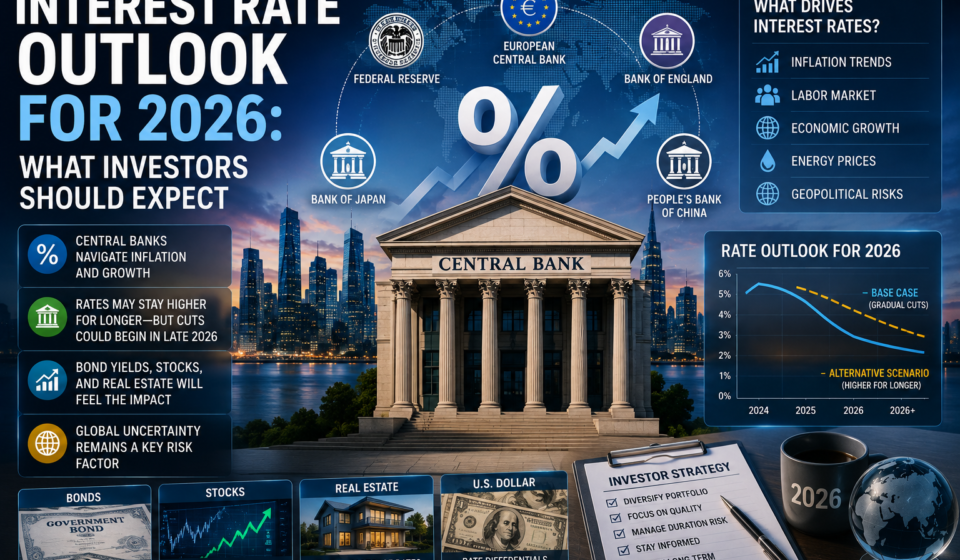

Interest Rate Outlook for 2026: What Investors Should Expect – Interest rates remain one of the most important forces shaping the global economy and financial markets. In 2026, investors are closely monitoring central bank decisions, inflation trends, economic growth forecasts, and geopolitical developments that could influence borrowing costs around the world. After several years of aggressive monetary policy adjustments aimed at controlling inflation, many market participants are asking the same question: where are interest rates headed next?
The answer carries significant implications for stocks, bonds, real estate, currencies, and business investment. Understanding the interest rate outlook for 2026 can help investors make informed decisions and prepare for potential opportunities and risks in an increasingly uncertain economic environment.
Why Interest Rates Matter
Interest rates influence nearly every aspect of the economy.
When central banks raise rates, borrowing becomes more expensive for consumers and businesses. Higher rates can slow spending, reduce investment, and help control inflation. Conversely, lower rates encourage borrowing, stimulate economic activity, and support growth.
Interest rates affect:
- Mortgage costs
- Business loans
- Credit card borrowing
- Bond yields
- Stock valuations
- Currency exchange rates
- Consumer spending
Because of their broad impact, interest rate decisions often trigger significant market reactions.
The Global Economic Environment in 2026
The interest rate outlook for 2026 is shaped by a complex economic backdrop.
Many major economies are experiencing slower growth compared to the rapid recovery periods seen earlier in the decade. Inflation has moderated in several regions but remains above long-term targets in some countries. Meanwhile, geopolitical tensions, trade disputes, and energy market volatility continue to create uncertainty.
Central banks are attempting to balance two competing objectives:
- Keeping inflation under control.
- Supporting economic growth and employment.
This balancing act is influencing monetary policy decisions across the world.
Inflation Remains the Key Factor
Inflation continues to be the most important variable affecting interest rate decisions.
Although inflation rates have declined from their peaks in many countries, central bankers remain cautious. Policymakers want to ensure that inflation is sustainably moving toward target levels before implementing significant rate reductions.
Key inflation drivers include:
- Energy prices
- Housing costs
- Wage growth
- Supply chain disruptions
- Consumer demand
- Geopolitical events
If inflation proves more persistent than expected, central banks may keep rates elevated for longer periods.
On the other hand, a rapid decline in inflation could create room for monetary easing.
Central Banks and Their Policy Direction
The world’s major central banks play a crucial role in shaping interest rate expectations.
The Federal Reserve
The U.S. Federal Reserve remains one of the most influential institutions in global financial markets.
Investors closely monitor Federal Reserve statements, economic projections, and policy meetings for clues regarding future rate decisions.
If inflation continues to moderate while economic growth slows, the Federal Reserve may gradually reduce rates during 2026. However, policymakers are likely to proceed cautiously to avoid reigniting inflation pressures.
The European Central Bank
The European Central Bank faces unique challenges related to economic growth, energy costs, and inflation across multiple member countries.
Weak economic activity in parts of Europe may increase pressure for rate cuts, but inflation risks could limit the pace of monetary easing.
Other Global Central Banks
Central banks in Asia, Latin America, and other regions are also adjusting policies based on local economic conditions.
Some emerging markets have already begun easing cycles, while others continue maintaining tighter monetary policies to support currency stability and inflation control.
Interest Rates and Bond Markets
Bond investors pay particularly close attention to interest rate expectations.
Bond prices and interest rates generally move in opposite directions. When rates rise, existing bonds often lose value because newer bonds offer higher yields. When rates fall, existing bonds become more attractive, potentially increasing their prices.
For investors, this creates both risks and opportunities.
In 2026, many analysts expect government and corporate bonds to remain important portfolio components due to their income-generating potential and diversification benefits.
Investors are carefully evaluating:
- Treasury yields
- Corporate bond spreads
- Inflation expectations
- Credit risks
- Duration exposure
Changes in interest rate expectations can significantly influence bond market performance.
The Impact on Stock Markets
Interest rates outlook also affect stock valuations.
Higher rates generally increase borrowing costs for businesses and reduce the present value of future earnings. This can place downward pressure on stock prices, particularly in growth-oriented sectors.
Lower rates often have the opposite effect by supporting economic activity and improving financial conditions.
Sectors that may respond differently to interest rate changes include:
Technology
Technology companies often benefit from lower rates because future growth expectations become more valuable.
Financials
Banks and financial institutions may benefit from certain interest rate environments that improve lending profitability.
Real Estate
Property-related investments are highly sensitive to financing costs and mortgage rates.
Consumer Goods
Consumer spending patterns often change as borrowing costs rise or fall.
Investors should recognize that interest rate movements can create winners and losers across different sectors.
Housing Markets and Mortgage Rates
Housing markets remain closely tied to interest rate trends.
Mortgage rates influence affordability, homebuyer demand, refinancing activity, and housing construction.
When rates are high:
- Monthly mortgage payments increase.
- Housing demand may weaken.
- Home price growth often slows.
When rates decline:
- Affordability improves.
- Housing demand may strengthen.
- Construction activity can increase.
Many housing analysts expect interest rate movements in 2026 to play a major role in determining real estate market performance across various countries.
Currency Markets and Interest Rate Differentials
Interest rates outlook are a key driver of currency values.
Investors often seek higher returns by allocating capital to countries offering relatively attractive interest rates outlook. This can strengthen certain currencies while weakening others.
Currency movements influence:
- International trade
- Foreign investment
- Commodity prices
- Corporate earnings
In 2026, differences in monetary policy among major economies may continue creating volatility in foreign exchange markets.
Investors with international exposure should pay close attention to interest rate differentials and currency risks.
Risks That Could Change the Outlook
Several factors could alter current interest rate expectations.
Persistent Inflation
If inflation remains stubbornly high, central banks may delay or reduce planned rate cuts.
Economic Recession
A significant economic slowdown could encourage faster monetary easing to support growth.
Geopolitical Events
Conflicts, sanctions, trade disputes, and energy supply disruptions can affect inflation and economic activity.
Financial Market Instability
Unexpected stress in banking systems or financial markets may require policy adjustments.
Labor Market Conditions
Strong employment growth and rising wages can influence inflation and monetary policy decisions.
Because these variables are difficult to predict, investors should remain flexible and prepared for changing conditions.
Investment Strategies for a Changing Rate Environment
Investors can consider several approaches when navigating uncertain interest rate conditions.
Diversification
A diversified portfolio can help reduce exposure to unexpected market movements.
Quality Investments
Companies with strong balance sheets and consistent cash flows may be better positioned during periods of economic uncertainty.
Fixed-Income Opportunities
Bonds may become increasingly attractive if rates stabilize or begin to decline.
Long-Term Perspective
Attempting to predict every central bank decision can be difficult. Long-term investment strategies often provide more reliable outcomes than short-term market timing.
Monitoring Economic Data
Key indicators such as inflation reports, employment figures, GDP growth, and central bank communications can provide valuable insights into future rate trends.
Successful investors remain informed while avoiding emotional reactions to short-term market volatility.
What Experts Are Watching in 2026
Market participants are closely tracking several indicators that could influence future interest rate decisions:
- Inflation trends
- Consumer spending data
- Labor market strength
- Wage growth
- Energy prices
- Housing market activity
- Manufacturing performance
- Global economic growth
These indicators help investors evaluate whether central banks are likely to maintain, raise, or lower interest rates outlook in the coming months.
The interaction between inflation and economic growth remains particularly important.
Conclusion
The interest rate outlook for 2026 remains one of the most closely watched topics in global finance. While inflation has generally eased from previous highs, central banks continue to balance the need for price stability with the desire to support economic growth.
For investors, interest rates outlook will continue influencing bonds, stocks, real estate, currencies, and overall market sentiment. Although expectations currently suggest a gradual shift toward lower rates in some regions, uncertainty remains high due to inflation risks, geopolitical developments, and economic conditions.
Rather than focusing solely on predicting rate decisions, investors may benefit from maintaining diversified portfolios, monitoring economic indicators, and staying committed to long-term financial goals. As monetary policy evolves throughout 2026, those who remain informed and adaptable will be better positioned to navigate changing market conditions and identify emerging investment opportunities.