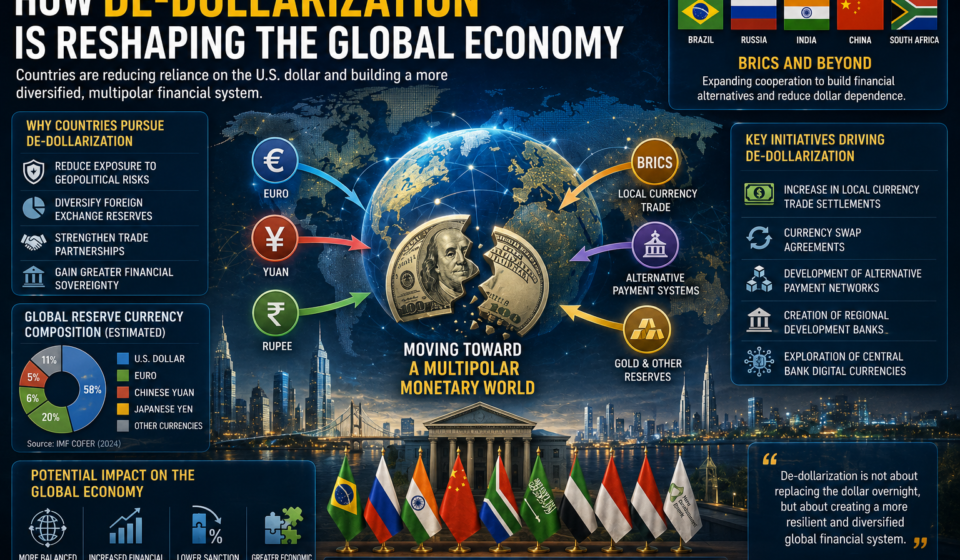

How De-Dollarization Is Reshaping the Global Economy – For decades, the U.S. dollar has been the dominant currency in global trade, international finance, and foreign exchange reserves. It has served as the world’s primary reserve currency, providing stability and liquidity for governments, businesses, and investors. However, a growing trend known as de-dollarization is beginning to reshape the global economic landscape.
De-dollarization refers to efforts by countries, financial institutions, and trading partners to reduce their dependence on the U.S. dollar in international transactions. While the dollar remains the most influential currency in the world, many nations are increasingly exploring alternative currencies, payment systems, and financial arrangements.
In 2026, de-dollarization has become one of the most widely discussed topics in economics and geopolitics. The movement reflects changing global power dynamics, evolving trade relationships, and growing interest in creating a more diversified international financial system.
What Is De-Dollarization?
De-dollarization is the process of reducing the use of the U.S. dollar in international trade, investment, reserves, and financial transactions.
Historically, the dollar became dominant because of the size of the U.S. economy, the strength of its financial markets, and widespread confidence in American institutions. As a result, many commodities, including oil, have traditionally been priced and traded in dollars.
Under de-dollarization initiatives, countries may:
- Conduct trade using local currencies.
- Increase reserves of non-dollar currencies.
- Develop alternative payment systems.
- Expand currency swap agreements.
- Diversify foreign exchange reserves.
- Strengthen regional financial cooperation.
The goal is not always to eliminate the dollar entirely but to reduce reliance on a single currency.
Why Countries Are Pursuing De-Dollarization
Several factors are driving interest in de-dollarization.
Geopolitical Considerations
Many governments want greater financial independence and reduced exposure to geopolitical risks.
Because the dollar plays such a central role in global finance, countries can be affected by U.S. monetary policy decisions, sanctions, and financial regulations.
Reducing dollar dependence can provide greater flexibility in managing economic relationships and international transactions.
Diversification Strategies
Investors and central banks often seek diversification to reduce risk.
Just as investors diversify portfolios, countries may diversify currency reserves to avoid excessive dependence on a single financial system.
Growing Economic Multipolarity
The global economy is becoming increasingly multipolar.
Emerging economies such as China, India, Brazil, and others are gaining economic influence and expanding trade relationships. As these countries grow, interest in using alternative currencies naturally increases.
Technological Innovation
Advances in financial technology, digital payment systems, and central bank digital currencies are creating new possibilities for international transactions outside traditional dollar-based networks.
The Role of BRICS in De-Dollarization
The BRICS group has become one of the most prominent supporters of de-dollarization efforts.
Composed of major emerging economies, BRICS members have increasingly discussed ways to strengthen financial cooperation and reduce dependence on the dollar for trade and investment.
Several initiatives include:
- Expanding local currency trade.
- Creating alternative payment mechanisms.
- Enhancing financial cooperation among member countries.
- Supporting regional development institutions.
As BRICS expands its global influence, its efforts contribute to broader discussions about the future of international finance.
However, building alternatives to the dollar-based system remains a complex and long-term challenge.
Local Currency Trade Agreements
One of the most visible aspects of de-dollarization is the growing use of local currencies in international trade.
Traditionally, many countries conducted trade transactions in dollars, even when neither trading partner was the United States.
Today, some nations are increasingly settling trade using their own currencies.
Potential benefits include:
- Reduced currency conversion costs.
- Lower exchange-rate risks.
- Increased financial autonomy.
- Enhanced regional trade cooperation.
While local currency arrangements remain relatively small compared to overall global trade, their usage continues to expand in several regions.
Central Bank Reserve Diversification
Central banks hold foreign exchange reserves to support financial stability and facilitate international transactions.
Historically, the U.S. dollar has represented the largest share of global reserves. However, some countries are gradually increasing allocations to other assets.
Alternative reserve holdings may include:
- Euro
- Chinese yuan
- Japanese yen
- Gold
- Other regional currencies
Gold, in particular, has attracted increased attention as central banks seek assets that are not directly tied to any single country’s monetary policy.
Reserve diversification is viewed by many governments as a prudent risk-management strategy in an evolving global environment.
Alternative Payment Systems
The international financial system relies heavily on payment networks that facilitate cross-border transactions.
Some countries are developing alternative systems to improve financial independence and reduce reliance on traditional infrastructure.
These efforts aim to:
- Improve transaction efficiency.
- Strengthen resilience.
- Support regional trade.
- Reduce exposure to external disruptions.
Although alternative systems are growing, the existing global financial infrastructure remains deeply integrated and highly influential.
Replacing or significantly reducing its role will require substantial investment, coordination, and trust among participating countries.
The Rise of Digital Currencies
Digital currencies are adding a new dimension to de-dollarization discussions.
Many central banks are exploring Central Bank Digital Currencies (CBDCs), which could potentially streamline international payments and reduce transaction costs.
Potential advantages include:
- Faster cross-border settlements.
- Reduced dependence on intermediary institutions.
- Improved transparency.
- Enhanced payment efficiency.
Some analysts believe digital currencies could eventually support greater currency diversification in international trade.
However, widespread adoption will depend on regulatory frameworks, technological development, and international cooperation.
Impact on Global Trade
De-dollarization could gradually reshape global trade patterns.
A more diversified currency environment may provide countries with greater flexibility in conducting international commerce.
Potential outcomes include:
- Increased regional trade integration.
- Expanded use of local currencies.
- Reduced transaction costs in some markets.
- Greater competition among international currencies.
At the same time, businesses may face additional complexities related to managing multiple currencies and exchange-rate fluctuations.
Global companies will need to adapt to evolving payment systems and financial arrangements as the international monetary landscape changes.
Implications for Investors
Investors are closely monitoring de-dollarization trends because of their potential impact on financial markets.
Areas that may be affected include:
Currency Markets
Greater use of alternative currencies could influence exchange rates and currency demand.
Commodity Markets
Many commodities are traditionally priced in dollars. Changes in settlement practices could affect pricing mechanisms over time.
Bond Markets
Reserve diversification strategies may influence demand for government bonds issued in different currencies.
Gold and Precious Metals
Increased reserve diversification often supports demand for gold as a store of value.
Emerging Markets
Countries benefiting from increased local currency trade and financial integration may attract additional investment.
While the transition is likely to be gradual, investors should remain aware of long-term structural shifts.
Challenges Facing De-Dollarization
Despite growing interest, de-dollarization faces significant obstacles.
Dollar Dominance Remains Strong
The U.S. dollar continues to benefit from:
- Deep financial markets
- High liquidity
- Global trust
- Established infrastructure
- Extensive international usage
These advantages are difficult to replicate.
Network Effects
The widespread use of the dollar creates powerful network effects.
Businesses, governments, and financial institutions often prefer using the currency that others already use.
Changing these habits requires considerable coordination.
Limited Alternatives
Although alternative currencies are gaining importance, none currently matches the dollar’s global reach and liquidity.
Economic and Political Risks
Some alternative currencies face challenges related to market transparency, capital controls, political stability, or financial market development.
These factors can limit their attractiveness as global reserve assets.
The Future of the Global Monetary System
Most experts do not expect the U.S. dollar to lose its dominant position overnight.
Instead, the future may involve a more diversified international monetary system where multiple currencies play important roles alongside the dollar.
Possible characteristics of this future include:
- Greater currency diversification
- Expanded local currency trade
- Increased use of digital payment technologies
- Stronger regional financial networks
- A more multipolar economic structure
Such changes would reflect broader shifts in global economic power rather than the complete replacement of existing financial systems.
Conclusion
De-dollarization is becoming an increasingly important trend in the global economy. Driven by geopolitical considerations, economic diversification strategies, technological innovation, and the rise of emerging markets, countries are exploring ways to reduce dependence on the U.S. dollar in international transactions.
Although the dollar remains the world’s dominant reserve currency, alternative payment systems, local currency trade agreements, reserve diversification efforts, and digital currencies are gradually reshaping the international financial landscape.
The transition toward a more diversified monetary system is likely to be gradual rather than revolutionary. Nevertheless, de-dollarization represents a significant shift in how nations think about trade, finance, and economic sovereignty. As these trends continue to evolve, they will play an increasingly important role in shaping the future of the global economy.