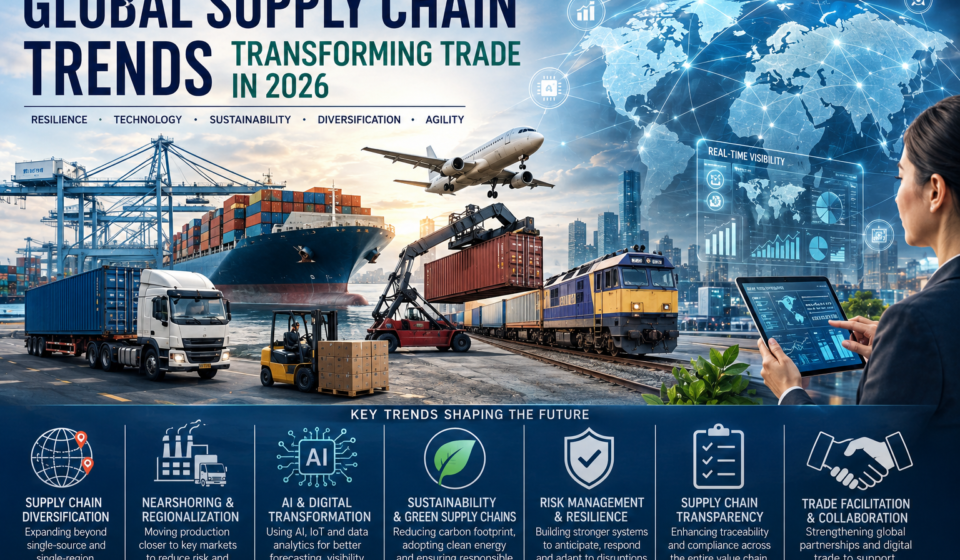

Global Supply Chain Trends Transforming Trade in 2026 – Global supply chains are undergoing a profound transformation in 2026. Over the past decade, businesses have faced a series of disruptions, including the COVID-19 pandemic, geopolitical tensions, trade disputes, labor shortages, climate-related events, and rapidly changing consumer expectations. These challenges have exposed vulnerabilities in traditional supply chain models and forced companies to rethink how goods move across the world.
Today, supply chains are no longer focused solely on efficiency and cost reduction. Resilience, flexibility, sustainability, and digital innovation have become equally important priorities. Governments and businesses are investing heavily in new technologies, regional manufacturing strategies, and risk management systems to ensure that global trade remains reliable in an increasingly uncertain environment.
As international commerce continues to evolve, several key supply chain trends are reshaping global trade and influencing business strategies worldwide.
The Shift from Efficiency to Resilience
For decades, companies optimized supply chains around efficiency and low production costs. Manufacturing was concentrated in regions with competitive labor costs, and businesses relied heavily on just-in-time inventory systems.
However, recent disruptions revealed the risks of overly concentrated supply networks. Companies learned that maximizing efficiency often came at the expense of resilience.
As a result, organizations are increasingly prioritizing supply chain resilience. According to research from the World Economic Forum, global supply chains have entered an era of “structural volatility,” prompting businesses to rethink sourcing, manufacturing, and investment decisions. Three out of four business leaders now view resilience as a key driver of growth.
Modern supply chains are being designed to withstand disruptions rather than simply minimize costs.
Supply Chain Diversification Accelerates
One of the most significant trends in 2026 is supplier diversification.
Rather than relying on a single country or supplier, companies are spreading production and sourcing activities across multiple regions.
This strategy helps reduce exposure to:
- Geopolitical tensions
- Trade restrictions
- Natural disasters
- Labor shortages
- Transportation disruptions
Many multinational firms are adopting a “China Plus One” strategy, maintaining operations in China while expanding manufacturing in countries such as Vietnam, India, Indonesia, and Mexico. Research examining global supply chain shifts shows that while companies are diversifying, many alternative supply chains remain connected to Chinese production networks, creating more complex regional trade structures.
Diversification has become a critical component of long-term risk management.
Regionalization and Nearshoring
Globalization is evolving rather than disappearing.
Instead of relying entirely on long-distance supply networks, many companies are moving production closer to key markets through nearshoring and regionalization.
Examples include:
- North American firms expanding manufacturing in Mexico.
- European companies strengthening regional production networks.
- Asian economies deepening regional supply chain integration.
Regionalization offers several advantages:
- Faster delivery times
- Lower transportation costs
- Reduced geopolitical risk
- Improved supply chain visibility
- Greater responsiveness to market demand
This shift is creating new trade patterns and investment opportunities across emerging manufacturing hubs.
Artificial Intelligence Is Revolutionizing Supply Chains
Artificial intelligence has become one of the most transformative technologies in global supply chain management.
Organizations are using AI to improve:
- Demand forecasting
- Inventory management
- Route optimization
- Risk monitoring
- Supplier analysis
- Production planning
The OECD identifies AI as one of the two most important forces reshaping modern supply chains, alongside environmental requirements. AI-driven analytics improve transparency, traceability, and risk management while helping companies respond more effectively to disruptions.
AI-powered systems can analyze vast amounts of data in real time, allowing businesses to detect potential disruptions before they become major problems.
As adoption increases, AI is becoming a competitive necessity rather than a technological luxury.
Greater Supply Chain Visibility
Supply chain visibility has become a major priority for businesses worldwide.
Companies increasingly want real-time information about:
- Inventory levels
- Supplier performance
- Shipping status
- Production schedules
- Potential risks
Modern digital platforms enable organizations to monitor supply chains from raw materials to final delivery.
This visibility helps businesses:
- Respond quickly to disruptions
- Improve customer service
- Reduce operational costs
- Strengthen supplier relationships
Advanced tracking technologies, cloud-based systems, and AI-powered monitoring tools are making supply chains more transparent than ever before.
Sustainability and Environmental Requirements
Environmental considerations are playing a larger role in supply chain management.
Governments, consumers, and investors are demanding greater sustainability throughout global supply networks.
The OECD reports that environmental requirements linked to market access are now one of the major forces transforming international trade and supply chains.
Companies are increasingly focusing on:
- Carbon footprint reduction
- Sustainable sourcing
- Energy efficiency
- Circular economy practices
- Waste reduction
- Green logistics
Many businesses are evaluating suppliers based not only on cost and quality but also on environmental performance.
Sustainability is becoming a strategic business objective as well as a regulatory requirement.
Supply Chain Transparency and Compliance
Regulatory requirements are becoming more complex across global markets.
Businesses must increasingly demonstrate compliance with:
- Labor standards
- Environmental regulations
- Trade restrictions
- Human rights requirements
- Product traceability rules
Recent developments in the United States and Europe are pushing companies to improve transparency throughout their supply networks. AI-powered compliance tools are helping organizations trace products, monitor suppliers, and identify risks more efficiently.
As regulations continue to evolve, supply chain transparency is becoming essential for maintaining market access and consumer trust.
Geopolitical Risks Reshape Trade Networks
Geopolitical uncertainty remains one of the biggest influences on supply chain strategy.
Trade disputes, sanctions, export controls, and regional conflicts are affecting sourcing decisions and investment plans.
The United Nations Conference on Trade and Development (UNCTAD) identifies geopolitical fragmentation as one of the primary forces reshaping global trade and value chains in 2026.
Meanwhile, growing technology competition between major economies is creating concerns about the emergence of separate digital ecosystems. Business leaders increasingly view geopolitical risk management as a core supply chain function rather than a secondary consideration.
Companies are investing more resources into scenario planning and contingency strategies to prepare for unexpected disruptions.
Climate Risks Become Supply Chain Risks
Climate change is increasingly affecting global logistics and trade.
Extreme weather events can disrupt:
- Shipping routes
- Manufacturing facilities
- Transportation infrastructure
- Agricultural production
- Energy supplies
Recent heatwaves and droughts in Europe have affected river transportation, agricultural output, and logistics operations, demonstrating how climate events can directly influence supply chain costs and efficiency.
As climate risks intensify, businesses are incorporating environmental resilience into supply chain planning.
Many organizations are investing in infrastructure upgrades, alternative transportation routes, and climate-risk assessments.
Digital Trade and Smart Manufacturing
Digital transformation continues to reshape manufacturing and logistics.
Technologies driving this transformation include:
- Cloud computing
- Internet of Things (IoT)
- Digital twins
- Robotics
- Advanced analytics
- Machine learning
Smart factories use connected systems to improve production efficiency, reduce waste, and respond quickly to market changes.
At the same time, digital trade platforms are streamlining customs procedures, documentation, and cross-border transactions.
These innovations help companies reduce costs while improving agility and responsiveness.
Trade Facilitation and Cross-Border Cooperation
Efficient trade facilitation is becoming increasingly important in a complex global environment.
The OECD highlights that streamlined customs procedures, digital documentation, and international cooperation can significantly improve supply chain resilience and efficiency.
Governments and international organizations are working to:
- Simplify border processes
- Improve customs efficiency
- Enhance digital trade systems
- Support interoperability between countries
These efforts can help businesses move goods more quickly and reduce administrative burdens.
As global trade becomes more interconnected, cooperation remains essential for maintaining efficient supply networks.
The Growing Role of Emerging Markets
Emerging economies are playing an increasingly important role in global supply chains.
Countries in Southeast Asia, South Asia, Latin America, and parts of Africa are attracting investment as businesses seek diversified production locations.
Key advantages often include:
- Competitive labor costs
- Expanding infrastructure
- Growing consumer markets
- Strategic geographic locations
This shift is creating new trade corridors and contributing to the development of regional manufacturing ecosystems.
Emerging markets are expected to remain important beneficiaries of supply chain diversification efforts in the coming years.
Supply Chain Risk Management Becomes Strategic
Risk management is no longer viewed as a support function.
Instead, it has become a strategic priority for corporate leadership.
Companies are investing in:
- Predictive analytics
- Scenario planning
- Alternative suppliers
- Inventory buffers
- Risk monitoring systems
Academic research shows that AI-driven systems are increasingly capable of detecting disruptions, mapping supply chain exposure, and recommending mitigation strategies in real time.
The ability to anticipate and respond to risks is becoming a major source of competitive advantage.
The Future of Global Supply Chains
Looking ahead, supply chains are expected to become more digital, diversified, sustainable, and resilient.
Several trends are likely to define the future:
- Greater AI adoption
- Expanded regional manufacturing networks
- Stronger sustainability requirements
- Increased supply chain transparency
- More sophisticated risk management
- Enhanced digital trade infrastructure
At the same time, companies will continue balancing efficiency with resilience as they adapt to changing economic and geopolitical realities.
Conclusion
Global supply chain trends in 2026 are transforming the way businesses operate and how goods move across international markets. The era of supply chains optimized solely for cost efficiency is giving way to a new model centered on resilience, diversification, visibility, sustainability, and technological innovation.
Artificial intelligence, regionalization, environmental compliance, geopolitical risk management, and digital transformation are reshaping global trade networks and influencing investment decisions worldwide. While challenges remain, these changes are also creating opportunities for businesses that can adapt effectively.
As the global economy continues to evolve, supply chains will remain at the center of international commerce, making their transformation one of the most important economic developments of the decade.