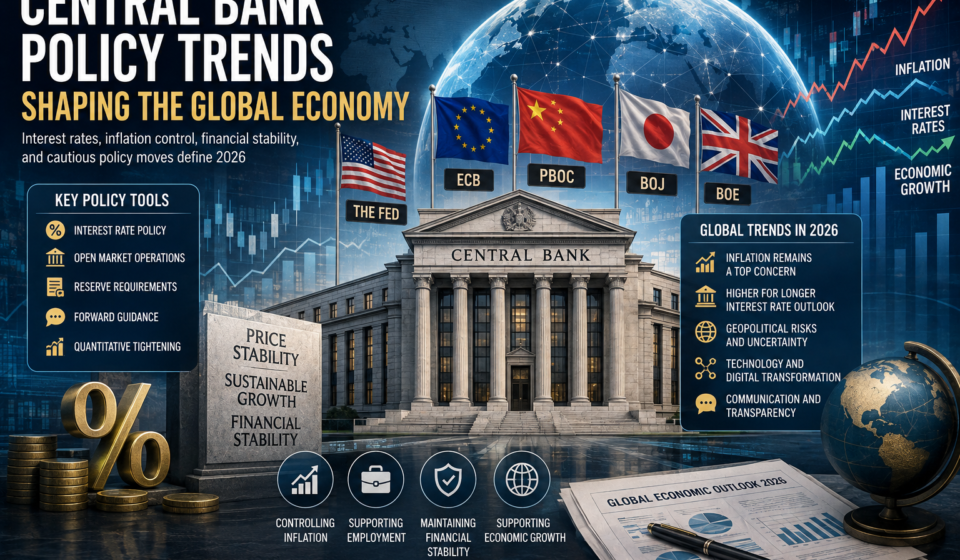

Central Bank Policy Trends Shaping the Global Economy – Central banks play a critical role in maintaining economic stability, controlling inflation, supporting employment, and ensuring the smooth functioning of financial systems. In 2026, central bank policies are having an even greater influence on global markets as policymakers navigate a complex environment marked by inflation concerns, geopolitical tensions, slowing growth, and rapid technological change.
From the U.S. Federal Reserve and the European Central Bank to the People’s Bank of China and Bank Indonesia, monetary authorities are carefully adjusting policies to balance economic growth with price stability. Their decisions affect borrowing costs, investment activity, currency values, consumer spending, and financial markets worldwide. Recent actions by major central banks show that inflation control remains a priority even as growth risks increase.
Understanding the latest central bank policy trends is essential for investors, businesses, and policymakers seeking to navigate an increasingly interconnected global economy.
The Growing Importance of Central Banks
Central banks are responsible for managing a country’s money supply and monetary policy. Their primary objective is often to maintain price stability, although many also support employment, financial stability, and sustainable economic growth. One of their most important tools is the ability to set interest rates, which influence borrowing, spending, and investment decisions throughout the economy.
In today’s globalized financial system, the actions of major central banks frequently extend beyond national borders. Changes in interest rates or monetary policy in one major economy can affect capital flows, exchange rates, trade, and investment around the world.
Inflation Control Remains a Top Priority
One of the dominant central bank policy trends in 2026 is the continued focus on inflation management.
Although inflation has eased in many countries compared to previous peaks, policymakers remain cautious. Several central banks have maintained relatively restrictive monetary policies because they want to ensure inflation returns to target levels before aggressively lowering interest rates. Recent discussions among Federal Reserve officials demonstrate ongoing concerns that inflation could remain above desired levels if policy becomes too accommodative too quickly.
Inflation affects households and businesses through:
- Higher living costs
- Increased borrowing expenses
- Rising wage pressures
- Reduced purchasing power
- Greater economic uncertainty
Because inflation influences nearly every aspect of economic activity, central banks continue to place significant emphasis on maintaining price stability.
Interest Rates as the Primary Policy Tool
Interest rate policy remains the most visible instrument used by central banks.
When inflation rises too quickly, central banks typically increase policy rates to reduce spending and slow demand. Conversely, when economic growth weakens significantly, they may lower rates to stimulate borrowing and investment.
The transmission mechanism works through the financial system by influencing the availability and cost of credit, ultimately affecting decisions made by businesses and households.
In 2026, policymakers are facing difficult choices because inflation risks and growth concerns often pull policy in opposite directions. As a result, many central banks are moving cautiously and emphasizing data-driven decision-making.
Balancing Growth and Stability
A key challenge for central banks is balancing economic growth with financial stability.
Maintaining interest rates that are too high for too long can slow economic activity and increase recession risks. However, reducing rates prematurely could reignite inflation and undermine confidence in monetary policy.
This balancing act has become increasingly difficult due to:
- Global trade disruptions
- Energy market volatility
- Geopolitical tensions
- Slower productivity growth
- Fiscal policy challenges
Recent central bank policy discussions across major economies highlight how central banks are attempting to maintain stability while remaining flexible enough to respond to changing economic conditions.
Central Bank Independence and Credibility
Another important trend is the growing emphasis on central bank credibility and independence.
Financial markets place significant value on predictable and transparent monetary policy. Investors, businesses, and consumers make long-term decisions based partly on expectations regarding inflation and interest rates.
Successful central banking often depends on:
- Policy independence
- Clear communication
- Transparency
- Consistency
- Institutional credibility
When market participants trust central banks to achieve their objectives, monetary policy tends to be more effective. Experts continue to view independence and credibility as essential foundations of successful monetary management.
Communication as a Policy Tool
Modern central banking involves much more than adjusting interest rates.
Communication has become a powerful policy instrument. Statements, press conferences, economic projections, and central bank policy guidance can influence financial markets even before actual policy changes occur.
Central banks increasingly use communication to:
- Manage market expectations
- Reduce uncertainty
- Explain policy decisions
- Guide future economic behavior
Research suggests that public narratives and media coverage of monetary policy can influence inflation expectations and economic activity, making communication an increasingly important aspect of policy effectiveness.
Managing Global Economic Uncertainty
The global economy faces numerous uncertainties in 2026.
Geopolitical conflicts, supply chain disruptions, energy market volatility, and trade tensions continue to create challenges for policymakers. Central banks must account for these risks when designing monetary policy.
For example, conflicts affecting energy supplies can increase inflation through higher fuel and transportation costs. Trade disruptions can affect production, investment, and consumer prices.
Recent economic assessments have highlighted the impact of geopolitical tensions on inflation and global growth prospects, reinforcing the need for careful central bank policy coordination.
Quantitative Tightening and Balance Sheet Management
In addition to interest rates, central banks are increasingly focused on managing the size of their balance sheets.
Following years of quantitative easing programs, many central banks have been reducing holdings of government bonds and other financial assets through a process known as quantitative tightening.
Objectives include:
- Normalizing monetary policy
- Reducing excess liquidity
- Restoring market-based pricing mechanisms
- Creating flexibility for future interventions
Balance sheet management has become an important complement to traditional interest rate central bank policy, although policymakers continue debating the optimal pace and scale of these adjustments.
Currency Stability and Exchange Rates
Central bank policies significantly influence currency values.
Interest rate differentials often affect capital flows between countries, which can strengthen or weaken currencies. Exchange rate movements impact:
- Trade competitiveness
- Import prices
- Inflation
- Foreign investment
- Economic growth
Several central banks are closely monitoring currency markets as fluctuations can complicate efforts to maintain price stability. In some cases, authorities may intervene directly or adjust central bank policy settings to support currency stability.
Technology and the Future of Monetary Policy
Technological innovation is beginning to reshape central banking.
Digital payment systems, artificial intelligence, big data analytics, and Central Bank Digital Currencies (CBDCs) are creating new opportunities and challenges.
Potential benefits include:
- Improved payment efficiency
- Better economic data collection
- Faster central bank policy analysis
- Enhanced financial inclusion
- Stronger financial system resilience
Many central banks are investing in technological capabilities to improve central bank policy effectiveness and adapt to changing financial landscapes.
The Role of Central Banks in Financial Stability
Beyond monetary policy, central banks play a crucial role in maintaining financial stability.
They often serve as:
- Lenders of last resort
- Banking supervisors
- Payment system operators
- Financial risk monitors
These responsibilities become especially important during periods of economic stress or market volatility.
By ensuring liquidity and monitoring systemic risks, central banks help reduce the likelihood of financial crises and support confidence in financial systems.
Emerging Market Perspectives
Central bank policy challenges are particularly complex in emerging markets.
These economies often face:
- Currency volatility
- Capital flow fluctuations
- External debt pressures
- Commodity price shocks
Policymakers must balance domestic growth objectives with external financial stability concerns.
Recent central bank policy actions in emerging economies demonstrate the importance of coordination between monetary, fiscal, and financial stability policies.
What Investors Should Watch
Investors seeking to understand future central bank actions should monitor:
- Inflation reports
- Employment data
- Economic growth indicators
- Wage trends
- Energy prices
- Central bank communications
- Financial market conditions
Changes in these indicators often influence policy decisions and market expectations.
Because monetary policy affects virtually all asset classes, staying informed about central bank developments remains essential for investment planning.
Conclusion
Central bank policy trends are playing a defining role in shaping the global economy in 2026. As policymakers work to balance inflation control, economic growth, financial stability, and geopolitical uncertainty, their decisions continue to influence markets, businesses, and households worldwide.
From interest rate adjustments and quantitative tightening to enhanced communication strategies and technological innovation, central banks are adapting to an increasingly complex economic environment. While challenges remain, effective monetary central bank policy remains one of the most important tools for promoting long-term stability and sustainable growth.
As the global economy continues to evolve, central bank policy will remain at the center of economic decision-making, making their policies essential for understanding the future direction of financial markets and economic development.