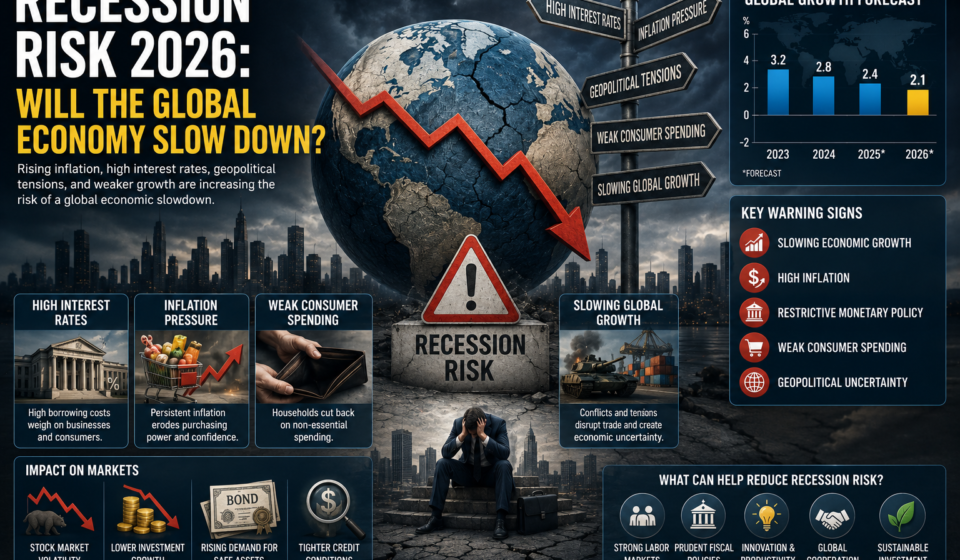

Recession Risk 2026: Will the Global Economy Slow Down? – As the world economy enters 2026, concerns about a potential recession remain a major topic among economists, investors, business leaders, and policymakers. While many countries have demonstrated resilience in the face of inflation, geopolitical tensions, and shifting monetary policies, uncertainty continues to cloud the global economic outlook.
The question facing markets is whether economic growth can remain stable or if mounting challenges will eventually trigger a broader slowdown. Recession risks vary across regions, but several common factors—including high interest rates, weakening consumer demand, global trade disruptions, and geopolitical instability—are influencing economic performance worldwide.
Understanding the drivers behind recession risk in 2026 can help businesses and investors prepare for potential economic shifts and identify opportunities in a changing environment.
What Is a Recession?
A recession is generally defined as a significant decline in economic activity that lasts for an extended period. It is often characterized by:
- Slower economic growth
- Rising unemployment
- Reduced consumer spending
- Lower business investment
- Declining industrial production
- Weakening trade activity
Although recessions are a natural part of economic cycles, their severity and duration can vary significantly.
Some downturns are relatively mild and short-lived, while others can have lasting effects on employment, financial markets, and household incomes.
Why Recession Concerns Are Rising in 2026
Several economic trends are fueling concerns about recession risks in 2026.
Slowing Global Growth
Many major economies are expanding at a slower pace than in previous years.
After periods of recovery and strong post-pandemic growth earlier in the decade, economic momentum has moderated. Businesses and consumers are becoming more cautious amid higher borrowing costs and ongoing uncertainty.
International organizations and economic analysts have revised growth forecasts in several regions, reflecting weaker demand and slower investment activity.
Elevated Interest Rates
Although inflation has eased in many countries, interest rates remain relatively high compared to historical norms.
Central banks implemented aggressive rate increases to combat inflation, and the effects continue to ripple through the economy.
Higher interest rates can:
- Reduce consumer spending
- Increase borrowing costs
- Slow housing markets
- Discourage business expansion
- Lower investment activity
These factors can collectively contribute to slower economic growth.
Inflation Remains a Challenge
Inflation continues to influence recession risks around the world.
While price pressures have moderated compared to peak levels seen earlier in the decade, inflation remains above target levels in some countries.
Persistent inflation creates challenges because it reduces household purchasing power and increases costs for businesses.
Consumers facing higher prices often cut discretionary spending, while companies may delay hiring or investment decisions.
At the same time, central banks may feel pressure to maintain restrictive monetary policies, which can further slow economic activity.
The delicate balance between controlling inflation and supporting growth remains one of the biggest challenges facing policymakers in 2026.
Consumer Spending Under Pressure
Consumer spending is a key driver of economic growth in many countries.
However, households continue to face several financial pressures, including:
- Higher living costs
- Elevated housing expenses
- Increased debt servicing costs
- Rising insurance premiums
- Expensive energy prices
As consumers become more cautious, spending on non-essential goods and services may decline.
Retail sales, travel demand, and discretionary purchases often provide early indicators of changes in consumer confidence.
A significant slowdown in consumer spending could increase the likelihood of broader economic weakness.
Labor Markets Provide Some Support
Despite recession concerns, labor markets remain relatively resilient in many economies.
Strong employment levels have helped support consumer incomes and economic activity.
Businesses in sectors such as healthcare, technology, construction, and renewable energy continue to face labor shortages in some regions.
However, labor market conditions are beginning to show signs of moderation.
Employers may become more selective in hiring decisions, and job growth could slow if economic uncertainty increases.
Because employment is closely linked to consumer spending, labor market trends will remain a critical factor in determining recession risks throughout 2026.
Global Trade Headwinds
International trade plays a crucial role in supporting economic growth.
However, several challenges are affecting global trade flows:
Geopolitical Tensions
Conflicts, sanctions, and diplomatic disputes continue to disrupt trade relationships and create uncertainty.
Protectionist Policies
Some countries are adopting policies designed to protect domestic industries, which can limit international commerce.
Supply Chain Adjustments
Businesses are restructuring supply chains to improve resilience and reduce dependence on specific regions.
While these adjustments may enhance long-term stability, they can create short-term inefficiencies and costs.
Weaker trade activity can reduce economic growth and increase recession risks in export-dependent economies.
Geopolitical Risks and Economic Uncertainty
Geopolitical developments remain one of the most unpredictable factors affecting the global economy.
Investors are closely monitoring issues such as:
- Energy security
- Regional conflicts
- Trade disputes
- Strategic competition among major powers
- Shipping and transportation disruptions
Geopolitical instability can influence commodity prices, investment decisions, consumer confidence, and financial markets.
Unexpected events often have ripple effects that extend beyond the regions directly involved.
As a result, geopolitical risks remain an important consideration in recession forecasts.
Housing Markets and Economic Growth
Housing markets are highly sensitive to interest rate changes.
In many countries, elevated mortgage rates have reduced affordability and slowed housing activity.
Potential consequences include:
- Lower home sales
- Reduced construction activity
- Declining refinancing demand
- Weaker consumer spending related to housing
Because housing contributes significantly to economic activity, prolonged weakness in property markets can increase recession risks.
However, conditions vary considerably across countries, with some regions experiencing greater resilience than others.
Financial Markets and Investor Sentiment
Financial markets often react quickly to changing economic expectations.
Stock market volatility, bond yields, and credit market conditions provide important signals about investor sentiment.
When recession concerns rise:
- Investors may seek safer assets.
- Business investment can decline.
- Credit conditions may tighten.
- Market volatility often increases.
At the same time, financial markets can recover rapidly if economic data improves or policymakers introduce supportive measures.
Investor confidence remains a key factor influencing economic momentum.
Regions Facing Different Levels of Risk
Recession risks are not uniform across the world.
United States
The U.S. economy continues to benefit from strong consumer spending and relatively healthy labor markets. However, high interest rates and slowing business investment remain concerns.
Europe
Several European economies face challenges related to weak growth, energy costs, and industrial competitiveness.
China
China’s economic outlook is influenced by domestic demand, property market conditions, and global trade dynamics.
Emerging Markets
Many emerging economies continue to grow faster than developed nations, although they remain vulnerable to external shocks, currency fluctuations, and commodity price movements.
These regional differences mean that economic performance is likely to vary significantly throughout 2026.
What Investors Should Watch
Investors seeking to assess recession risks should monitor several key indicators.
Economic Growth Data
GDP reports provide insight into overall economic performance.
Employment Trends
Changes in hiring activity and unemployment rates often signal shifts in economic conditions.
Inflation Reports
Inflation influences central bank policy and consumer purchasing power.
Interest Rate Decisions
Central bank actions remain critical for financial markets and economic growth.
Consumer Confidence
Consumer sentiment can provide early warning signs of spending changes.
Business Investment
Corporate spending plans often reflect expectations about future economic conditions.
Monitoring these indicators can help investors identify potential risks and opportunities.
How Businesses Can Prepare
Businesses can take proactive steps to manage uncertainty and strengthen resilience.
Strategies may include:
- Maintaining strong cash reserves
- Improving operational efficiency
- Diversifying revenue sources
- Investing in technology
- Managing debt carefully
- Strengthening supply chains
Organizations that remain flexible and adaptable are often better positioned to navigate periods of economic volatility.
Preparation can help reduce the impact of potential downturns while preserving opportunities for growth.
The Outlook for 2026
While recession risks remain elevated, many economists do not expect a severe global downturn.
Several supportive factors continue to provide stability:
- Relatively healthy labor markets
- Technological innovation
- Infrastructure investment
- Expanding renewable energy sectors
- Growing demand in certain emerging markets
However, slower growth appears more likely than a period of rapid economic expansion.
The combination of high borrowing costs, geopolitical uncertainty, and cautious consumer behavior suggests that economic conditions may remain challenging throughout the year.
Conclusion
Recession risk in 2026 remains a significant concern for governments, businesses, investors, and households worldwide. Slowing growth, elevated interest rates, inflation pressures, geopolitical tensions, and weaker consumer spending are all contributing to economic uncertainty.
While many economies continue to demonstrate resilience, the possibility of slower growth cannot be ignored. Policymakers face the difficult task of balancing inflation control with economic support, while businesses and investors must adapt to changing conditions.
Although a global recession is not inevitable, the risks are real enough to warrant careful monitoring. Those who stay informed, maintain flexibility, and focus on long-term strategies will be better positioned to navigate the challenges and opportunities that may emerge in the evolving economic landscape of 2026.