
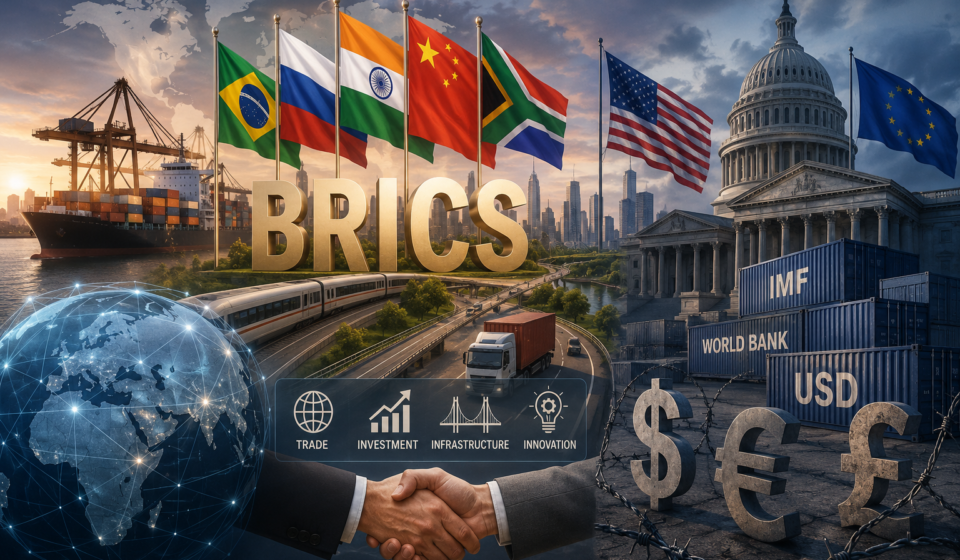

How BRICS Economic Expansion Is Challenging Western Dominance – The global economic landscape is undergoing a significant transformation, and one of the most important developments is the rapid expansion of BRICS. Originally formed by Brazil, Russia, India, China, and South Africa, the BRICS group has evolved into a powerful coalition of emerging economies seeking a greater role in global governance, trade, and finance. With the addition of new member countries and growing economic cooperation, BRICS is increasingly viewed as a counterbalance to the traditional influence of Western powers led by the United States and Europe.
As the world moves toward a more multipolar order, BRICS economic expansion is reshaping international trade, investment flows, and geopolitical relationships. This shift has sparked debates about whether the Western-dominated global system is entering a new era of competition and adjustment.
Understanding the Rise of BRICS
The BRICS alliance was created to provide a platform for major emerging economies to coordinate economic policies and promote mutual development. Collectively, BRICS countries represent a substantial share of the world’s population, natural resources, manufacturing capacity, and economic output.
What began as a relatively informal partnership has evolved into a more structured organization with ambitions that extend beyond economic cooperation. BRICS leaders regularly discuss issues such as global trade reform, financial stability, technological development, energy security, and international governance.
The group’s expansion reflects growing dissatisfaction among many developing nations with institutions and systems traditionally dominated by Western countries. As a result, BRICS Economic Expansion has become an attractive platform for nations seeking greater representation and influence on the global stage.
Economic Weight and Market Power
One of the primary reasons BRICS is gaining influence is its enormous economic scale. Together, BRICS countries account for a significant portion of global GDP when measured by purchasing power parity, and their combined populations represent billions of consumers.
China remains the largest economic force within the group, serving as a manufacturing powerhouse and major trading partner for countries around the world. India has emerged as one of the fastest-growing major economies, while Brazil and South Africa contribute valuable natural resources and regional influence. Russia continues to play a critical role in global energy markets.
The combined economic strength of these nations allows BRICS Economic Expansion to negotiate trade agreements, attract foreign investment, and influence commodity markets on a scale that increasingly rivals Western economies.
As member countries continue to grow and new economies join the bloc, BRICS gains additional leverage in shaping global economic trends.
Expanding Membership and Global Reach
The expansion of BRICS membership marks a turning point in the organization’s evolution. New members bring additional economic resources, strategic locations, and political influence.
Many countries in Africa, the Middle East, Asia, and Latin America have expressed interest in closer cooperation with BRICS. These nations often see the bloc as an alternative platform that offers opportunities for economic development without the political conditions sometimes associated with Western institutions.
The growing appeal of BRICS highlights a broader trend in international relations: developing countries increasingly want a larger voice in decisions affecting global trade, finance, and development.
As membership expands, BRICS becomes more representative of the Global South, strengthening its position as a coalition capable of challenging existing power structures.
Challenging the Dominance of the U.S. Dollar
One of the most discussed aspects of BRICS economic expansion is the effort to reduce dependence on the U.S. dollar in international trade.
For decades, the dollar has served as the world’s primary reserve currency, giving the United States significant influence over global financial systems. International trade, energy transactions, and foreign exchange reserves have largely relied on dollar-based mechanisms.
However, BRICS Economic Expansion nations are increasingly exploring alternatives. Bilateral trade agreements using local currencies have become more common, and discussions about creating new payment systems continue to gain momentum.
The objective is not necessarily to replace the dollar immediately but to diversify financial arrangements and reduce vulnerability to external economic pressures.
If these efforts continue to expand, they could gradually alter the balance of financial power and create a more decentralized global monetary system.
The Role of the New Development Bank
Another important tool supporting BRICS expansion is the New Development Bank (NDB), established to finance infrastructure and sustainable development projects.
The NDB was created as an alternative source of funding for emerging economies. While institutions such as the World Bank and the International Monetary Fund have historically played dominant roles in development financing, BRICS leaders sought a structure that would provide additional options for borrowing nations.
The bank funds projects related to transportation, renewable energy, water systems, digital infrastructure, and economic development.
By expanding access to capital and encouraging regional investment, the NDB strengthens economic ties among member countries and supports long-term growth.
Its existence also symbolizes the broader BRICS goal of building institutions that complement or compete with established Western-led organizations.
Trade Networks Beyond Traditional Western Markets
BRICS expansion is accelerating the diversification of global trade networks.
Historically, many developing countries relied heavily on trade relationships with North America and Europe. While these markets remain important, emerging economies are increasingly trading with one another.
South-South trade has grown significantly over the past two decades, creating new supply chains and reducing dependence on traditional economic centers.
China’s extensive manufacturing capabilities, India’s technology sector, Brazil’s agricultural exports, Russia’s energy resources, and Africa’s growing consumer markets are creating powerful economic synergies.
These evolving trade relationships are helping BRICS countries strengthen economic resilience and expand their influence in global commerce.
Energy Security and Strategic Resources
Energy plays a central role in the growing influence of BRICS Economic Expansion.
Several BRICS members and partner countries possess vast reserves of oil, natural gas, and critical minerals needed for modern technologies. These resources are essential for industries such as renewable energy, electric vehicles, semiconductors, and advanced manufacturing.
As global demand for energy and strategic materials increases, countries controlling these resources gain greater economic and geopolitical significance.
Cooperation among BRICS nations on energy production, infrastructure investment, and resource development enhances the group’s ability to shape global markets.
This influence extends beyond economics, affecting international diplomacy and strategic partnerships around the world.
Technology and Innovation as Growth Drivers
Economic power in the twenty-first century increasingly depends on technological innovation.
BRICS countries are investing heavily in artificial intelligence, telecommunications, digital payments, advanced manufacturing, and scientific research.
China has become a global leader in areas such as e-commerce, electric vehicles, and renewable energy technologies. India continues to strengthen its reputation as a major technology and software hub. Other BRICS members are expanding their digital infrastructure and innovation ecosystems.
By investing in technology, BRICS nations aim to reduce reliance on Western firms and create competitive industries capable of serving global markets.
The development of independent technological capabilities is becoming a critical component of the broader effort to achieve greater economic autonomy.
Obstacles Facing BRICS Expansion
Despite its growing influence, BRICS Economic Expansion faces several challenges.
The member countries differ significantly in terms of political systems, economic structures, strategic interests, and regional priorities. Managing these differences can be complex.
Economic disparities within the bloc also present difficulties. China possesses a much larger economy than most other members, which can create concerns about balance and decision-making.
Geopolitical tensions, trade disputes, and varying national interests may occasionally limit the effectiveness of collective action.
Additionally, replacing or substantially reducing the influence of established Western institutions is a long-term process that requires sustained cooperation and economic integration.
The success of BRICS will depend on its ability to overcome internal differences while maintaining a shared vision for growth and development.
What the Future May Hold
The continued expansion of BRICS suggests that the global economy is becoming increasingly multipolar.
Rather than a world dominated by a single economic center, the future may feature multiple influential blocs competing and cooperating simultaneously. In this environment, emerging economies are likely to play a larger role in shaping trade rules, investment patterns, financial systems, and technological standards.
Western countries will remain major economic powers, but they may face greater competition from rapidly growing economies across Asia, Africa, Latin America, and the Middle East.
For businesses, investors, and policymakers, understanding the rise of BRICS is becoming essential. The bloc’s growing economic influence is already affecting global markets, and its impact is expected to expand in the coming years.
Conclusion
BRICS economic expansion represents one of the most significant shifts in the modern global economy. Through growing trade networks, financial cooperation, technological investment, and institutional development, the bloc is steadily increasing its influence on the world stage.
While Western nations continue to hold substantial economic and political power, BRICS is providing an alternative model for international cooperation and development. Its efforts to diversify trade, reduce dependence on traditional financial systems, and strengthen ties among emerging economies are contributing to a more balanced and multipolar global order.
As the twenty-first century progresses, the competition and collaboration between BRICS and Western powers will likely shape the future of global economics, politics, and international relations for decades to come.
