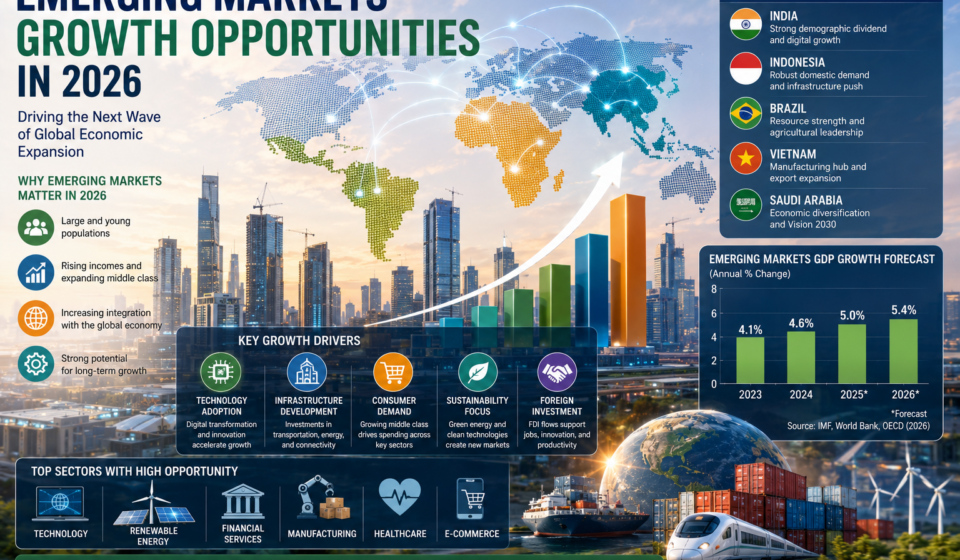

Emerging Markets Growth Opportunities in 2026 – Emerging markets have long been considered some of the most dynamic and promising areas of the global economy. In 2026, they continue to attract the attention of investors, multinational corporations, policymakers, and entrepreneurs seeking growth opportunities beyond mature developed economies. While advanced economies face challenges such as aging populations, slower productivity growth, and economic uncertainty, many emerging markets are benefiting from expanding middle classes, urbanization, digital transformation, and rising investment flows.
The global economic landscape is changing rapidly, and emerging economies are playing an increasingly important role in shaping trade, manufacturing, technology adoption, and consumer demand. Countries across Asia, Latin America, the Middle East, Africa, and parts of Eastern Europe are becoming critical contributors to global growth.
Understanding Emerging Markets Growth trends in 2026 can help businesses and investors identify opportunities while navigating the risks associated with these rapidly evolving economies.
What Are Emerging Markets?
Emerging markets are countries experiencing rapid industrialization, economic development, and integration into the global economy. These economies typically exhibit higher growth rates than developed nations while also offering significant opportunities for investment and business expansion.
Characteristics of emerging markets often include:
- Growing middle-class populations
- Expanding consumer spending
- Improving infrastructure
- Rising foreign investment
- Industrial development
- Increasing urbanization
- Strong demographic trends
Examples of important emerging markets include India, Indonesia, Vietnam, Brazil, Mexico, Saudi Arabia, South Africa, and several other fast-growing economies.
These countries are becoming increasingly influential in global trade, investment, and economic growth.
Why Emerging Markets Matter in 2026
The importance of Emerging Markets Growth has increased significantly over the past decade.
Many developed economies are experiencing slower growth due to demographic challenges and mature markets. In contrast, emerging economies continue to generate strong demand, attract investment, and expand their industrial capacity.
Several factors contribute to their growing importance:
- Larger working-age populations
- Rising household incomes
- Increasing technology adoption
- Expanding domestic markets
- Infrastructure development
- Greater participation in global trade
As a result, emerging markets are expected to account for a substantial share of global economic growth in the coming years.
Demographic Advantages Drive Expansion
One of the most significant drivers of Emerging Markets Growth is favorable demographics.
Many emerging economies have younger populations compared with developed countries.
A younger workforce offers several advantages:
- Larger labor supply
- Greater consumer demand
- Increased entrepreneurship
- Higher long-term growth potential
Countries such as India, Indonesia, and several African nations are benefiting from demographic trends that support economic expansion.
As millions of people enter the workforce and join the middle class, demand for housing, transportation, technology, healthcare, and financial services continues to grow.
This demographic momentum provides a strong foundation for future development.
Expanding Middle-Class Consumption
Consumer spending remains a major growth engine in emerging markets.
Rising incomes are creating larger middle-class populations with increasing purchasing power.
This trend supports demand across numerous sectors, including:
- Retail
- Consumer goods
- Healthcare
- Education
- Travel
- Financial services
- Entertainment
- Technology
Businesses seeking long-term growth opportunities often view emerging markets as attractive destinations because of their expanding consumer bases.
As living standards improve, spending patterns continue evolving toward higher-value goods and services.
Digital Transformation Creates New Opportunities
Technology adoption is accelerating across emerging economies.
Mobile connectivity, internet access, cloud computing, artificial intelligence, and digital payments are transforming how businesses operate and how consumers interact with products and services.
Key areas of growth include:
- E-commerce
- Fintech
- Digital banking
- Online education
- Telemedicine
- Artificial intelligence
- Software services
Many emerging markets are leapfrogging traditional development stages by adopting advanced digital solutions directly.
This rapid technological transformation is creating opportunities for local entrepreneurs as well as international investors.
Digital innovation is becoming a critical driver of Emerging Markets Growth.
Infrastructure Development Supports Economic Expansion
Infrastructure investment remains one of the most important foundations of long-term economic growth.
Many emerging economies are investing heavily in:
- Transportation networks
- Ports
- Airports
- Energy systems
- Telecommunications
- Industrial zones
- Smart city projects
Improved infrastructure increases productivity, reduces business costs, and attracts foreign investment.
Governments recognize that modern infrastructure is essential for supporting economic competitiveness and expanding participation in global trade.
Large-scale infrastructure programs are expected to continue driving growth throughout 2026 and beyond.
Foreign Direct Investment Remains Strong
Foreign direct investment (FDI) continues to play a crucial role in supporting Emerging Markets Growth.
Multinational corporations are investing in emerging economies to access:
- Growing consumer markets
- Competitive labor costs
- Strategic locations
- Natural resources
- Manufacturing capacity
FDI often brings:
- Capital investment
- Technology transfer
- Job creation
- Skills development
- Productivity improvements
Countries that maintain stable economic policies and attractive business environments tend to attract higher levels of foreign investment.
As global companies diversify operations, many emerging markets are benefiting from increased investment flows.
Supply Chain Diversification Benefits Emerging Economies
One of the most important trends shaping global commerce is supply chain diversification.
Businesses are increasingly reducing dependence on single-country production strategies and expanding manufacturing across multiple regions.
This trend is creating significant opportunities for emerging markets.
Countries such as:
- India
- Vietnam
- Indonesia
- Mexico
- Thailand
- Malaysia
are attracting manufacturing investment as companies seek greater supply chain resilience.
The shift toward regional production networks is strengthening industrial development and supporting export growth.
For many emerging economies, supply chain diversification represents a major opportunity for long-term expansion.
Manufacturing Growth Accelerates
Manufacturing continues to serve as a key driver of economic development.
Many emerging markets are expanding industrial capacity in areas such as:
- Electronics
- Automotive production
- Consumer goods
- Renewable energy equipment
- Semiconductor components
- Industrial machinery
Industrial growth contributes to:
- Employment creation
- Export earnings
- Productivity improvements
- Technology adoption
As companies seek new production locations, emerging economies with strong infrastructure and supportive policies are likely to benefit significantly.
Manufacturing remains central to many Emerging Markets Growth strategies.
The Rise of Renewable Energy Investment
The global energy transition is creating substantial opportunities for emerging economies.
Many countries possess abundant renewable energy resources, including:
- Solar power
- Wind energy
- Hydroelectric capacity
- Critical minerals
Investments in renewable energy projects help:
- Improve energy security
- Attract foreign capital
- Create jobs
- Support sustainable growth
Emerging markets also play a crucial role in supplying critical minerals needed for electric vehicles, batteries, and clean energy technologies.
This positions them to benefit from long-term shifts toward sustainability.
Financial Inclusion Expands Economic Participation
Financial inclusion continues improving across many emerging economies.
Digital banking and mobile payment platforms are helping millions of people gain access to financial services for the first time.
Benefits include:
- Increased savings
- Greater access to credit
- Improved business formation
- Enhanced economic participation
Fintech innovation has become one of the most important contributors to Emerging Markets Growth.
By expanding access to financial tools, emerging economies can support entrepreneurship and stimulate economic activity.
Urbanization Drives Demand
Urbanization remains a powerful growth trend.
Millions of people continue moving from rural areas to cities in search of employment and economic opportunities.
Urbanization increases demand for:
- Housing
- Transportation
- Utilities
- Healthcare
- Education
- Retail services
As cities expand, governments and businesses must invest in infrastructure and public services to support growing populations.
Urban development creates significant opportunities across multiple industries.
Natural Resources and Commodity Exports
Many emerging economies possess valuable natural resources that support economic growth.
Important exports include:
- Oil and gas
- Agricultural products
- Industrial metals
- Rare earth minerals
- Precious metals
Commodity demand remains influenced by industrial activity, energy transitions, and global trade trends.
While commodity dependence can create volatility, resource-rich countries often benefit from periods of strong global demand.
Effective resource management can support long-term development and investment.
Risks Facing Emerging Markets
Despite strong opportunities, several risks can affect Emerging Markets Growth.
Currency Volatility
Exchange rate fluctuations can impact investment returns and economic stability.
Political Uncertainty
Changes in government policies may affect business confidence.
External Debt Pressures
High debt levels can limit fiscal flexibility.
Global Economic Slowdowns
Reduced demand from major economies can affect exports.
Geopolitical Tensions
International conflicts may disrupt trade and investment flows.
Investors and businesses must carefully evaluate these risks when operating in emerging economies.
Opportunities for Investors
Emerging markets offer diverse investment opportunities across multiple sectors.
Areas attracting investor interest include:
- Technology
- Infrastructure
- Renewable energy
- Financial services
- Manufacturing
- Healthcare
- Consumer goods
Many emerging-market companies are benefiting from strong domestic demand and favorable long-term growth trends.
Investors seeking diversification and growth potential often allocate a portion of their portfolios to emerging economies.
However, careful research and risk management remain essential.
Government Reforms and Economic Competitiveness
Many emerging-market governments are implementing reforms designed to improve competitiveness.
Common initiatives include:
- Regulatory modernization
- Infrastructure investment
- Tax incentives
- Education improvements
- Digital transformation programs
These reforms help attract investment and support economic development.
Countries that successfully improve governance and business environments are often better positioned to achieve sustained growth.
The Future of Emerging Markets Growth
Looking ahead, several trends are expected to shape Emerging Markets Growth over the coming decade:
- Expanding digital economies
- Rising consumer spending
- Continued urbanization
- Supply chain diversification
- Renewable energy investment
- Infrastructure development
- Growing middle classes
These structural drivers provide strong support for long-term economic expansion.
While challenges remain, emerging markets are expected to continue increasing their influence within the global economy.
Conclusion
Emerging Markets Growth remains one of the most important themes shaping the global economy in 2026. Driven by favorable demographics, expanding middle classes, technological innovation, infrastructure investment, and increasing participation in global trade, emerging economies offer significant opportunities for businesses and investors alike.
Countries across Asia, Latin America, Africa, and the Middle East are becoming increasingly important engines of economic growth. While risks such as political uncertainty, currency volatility, and global economic fluctuations remain, the long-term outlook for many emerging markets remains positive.
As digital transformation accelerates and investment continues flowing into high-growth regions, emerging markets are likely to play an even larger role in shaping global economic development throughout the coming decade.
This content is sponsored by: https://ez96official.com/.