
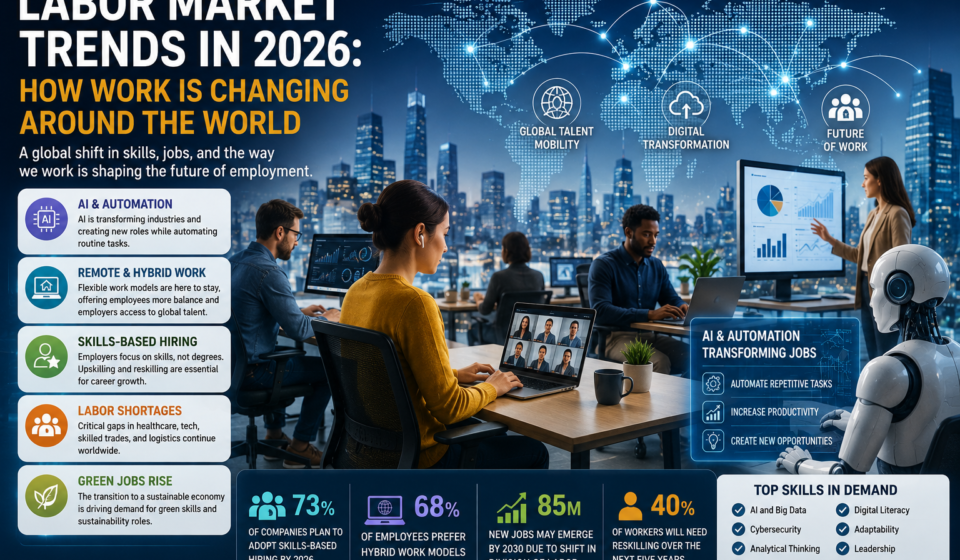

Labor Market Trends in 2026: How Work Is Changing Around the World – The global labor market is undergoing one of the most significant transformations in modern history. Technological innovation, demographic shifts, economic uncertainty, and changing employee expectations are reshaping how people work and how organizations operate. In 2026, businesses are adapting to a rapidly evolving workforce, while workers are developing new skills to remain competitive in an increasingly digital economy.
The concept of employment itself is changing. Traditional career paths are becoming less predictable, remote work continues to influence workplace culture, and automation is transforming job responsibilities across industries. Understanding the latest labor market trends is essential for employers, employees, investors, and policymakers seeking to navigate the future of work.
The Continued Rise of Digital Transformation
Digital transformation remains one of the strongest forces shaping labor markets worldwide.
Companies across industries are investing heavily in cloud computing, cybersecurity, automation, data analytics, and digital infrastructure. These investments are creating demand for workers with technical skills while reducing the need for certain repetitive tasks.
Businesses increasingly rely on digital tools to improve efficiency, reduce costs, and enhance customer experiences. As a result, employees who understand technology and digital workflows are becoming increasingly valuable.
Jobs related to software development, data science, cybersecurity, digital marketing, and IT support continue to experience strong demand in many regions.
The ability to adapt to new technologies is now considered a core career skill rather than a specialized capability.
Artificial Intelligence Is Reshaping Jobs
Artificial intelligence is one of the most discussed labor market trends in 2026.
AI is not simply replacing jobs; it is transforming them. Many workers now use AI-powered tools to increase productivity, automate routine tasks, and improve decision-making.
Professionals in fields such as finance, healthcare, customer service, education, marketing, and logistics are integrating AI into their daily workflows.
While some administrative and repetitive tasks are becoming automated, new roles are emerging in areas such as:
- AI development
- AI governance
- Prompt engineering
- Data management
- Machine learning operations
- AI ethics and compliance
The labor market trends is increasingly rewarding workers who can collaborate effectively with AI systems rather than compete against them.
Skills-Based Hiring Gains Momentum
Many employers are shifting away from traditional hiring practices that focus heavily on degrees and academic credentials.
Instead, organizations are prioritizing practical skills, experience, and demonstrated abilities.
Skills-based hiring allows companies to access larger talent pools while reducing barriers for qualified candidates who may not possess conventional educational backgrounds.
Employers increasingly evaluate candidates through:
- Skills assessments
- Professional certifications
- Project portfolios
- Work experience
- Technical demonstrations
This trend benefits workers who continuously develop their skills through online learning, vocational training, and professional development programs.
As industries evolve rapidly, lifelong learning is becoming essential for career success.
Remote and Hybrid Work Remain Popular
The workplace landscape has changed dramatically since remote work became mainstream.
In 2026, hybrid work models continue to dominate many professional industries. Employees increasingly expect flexibility regarding where and how they work.
Many organizations have adopted arrangements that combine office collaboration with remote productivity.
Benefits of hybrid work include:
- Greater flexibility
- Reduced commuting time
- Improved work-life balance
- Access to broader talent pools
- Lower operational costs for employers
However, companies also face challenges related to communication, team cohesion, employee engagement, and cybersecurity.
Successful organizations are investing in digital collaboration tools and management strategies that support distributed workforces.
Growing Demand for Specialized Skills
Rapid technological change is increasing demand for highly specialized skills.
Employers are actively seeking professionals with expertise in:
- Artificial intelligence
- Cybersecurity
- Data analytics
- Cloud computing
- Renewable energy
- Healthcare technology
- Financial technology
- Robotics and automation
At the same time, soft skills remain critically important.
Communication, problem-solving, leadership, adaptability, creativity, and emotional intelligence continue to distinguish high-performing employees.
The most successful workers combine technical expertise with strong interpersonal capabilities.
Labor Shortages in Key Industries
Despite economic uncertainty in some regions, labor shortages persist across numerous sectors.
Industries experiencing significant workforce gaps include:
Healthcare
Aging populations and growing healthcare demands are increasing the need for doctors, nurses, caregivers, and medical specialists.
Skilled Trades
Construction, manufacturing, electrical work, and plumbing continue to face shortages of qualified workers.
Technology
Demand for software engineers, cybersecurity experts, and data professionals often exceeds available talent.
Logistics and Transportation
Global supply chains rely on drivers, warehouse workers, and logistics specialists, many of whom remain in short supply.
These shortages are encouraging employers to offer competitive salaries, enhanced benefits, and workforce development initiatives.
The Rise of the Gig Economy
The gig economy continues to expand as workers seek flexibility and additional income opportunities.
Freelancers, independent contractors, consultants, and platform-based workers are becoming an increasingly important part of the global workforce.
Digital platforms make it easier for individuals to offer services ranging from graphic design and software development to delivery and transportation.
Many professionals appreciate the flexibility and autonomy associated with gig work.
However, concerns remain regarding:
- Income stability
- Employment protections
- Healthcare benefits
- Retirement planning
Governments and regulators are actively exploring policies to address these challenges while supporting labor market trends innovation.
Workforce Diversity and Inclusion
Diversity, equity, and inclusion remain major priorities for employers around the world.
Organizations increasingly recognize that diverse teams can improve innovation, decision-making, and overall business performance.
Companies are implementing initiatives aimed at expanding opportunities for underrepresented groups and creating more inclusive workplace cultures.
Diversity efforts often focus on:
- Gender representation
- Cultural diversity
- Disability inclusion
- Age diversity
- Equal career advancement opportunities
As global talent markets become more competitive, inclusive workplaces may gain advantages in attracting and retaining skilled employees.
Employee Well-Being Takes Center Stage
Employee well-being has become a strategic priority for many organizations.
Workers increasingly value employers that support mental health, work-life balance, and overall wellness.
In response, companies are investing in:
- Mental health programs
- Flexible schedules
- Wellness initiatives
- Professional development opportunities
- Employee assistance services
Research continues to show that healthier and more engaged employees tend to be more productive and less likely to leave their organizations.
As a result, well-being is increasingly viewed as both a human and business imperative.
Globalization and Talent Mobility
Technology has expanded access to global talent markets.
Many companies now recruit employees from different countries and regions, allowing organizations to access specialized skills regardless of geographic location.
Remote work has accelerated this trend by enabling professionals to work for international employers without relocating.
This growing talent mobility offers benefits such as:
- Access to broader expertise
- Increased workforce flexibility
- Greater diversity
- Expanded career opportunities
However, organizations must also navigate regulatory, tax, legal, and cultural challenges associated with managing international teams.
Green Jobs and Sustainability Careers
The global transition toward sustainability is creating new employment opportunities.
Governments and businesses are investing heavily in:
- Renewable energy
- Electric vehicles
- Sustainable construction
- Environmental consulting
- Energy efficiency technologies
- Climate adaptation projects
These investments are generating demand for workers with expertise in environmental science, engineering, project management, and sustainability strategy.
Many analysts expect green jobs to become one of the fastest-growing segments of the labor market trends over the next decade.
The shift toward a lower-carbon economy is creating both challenges and opportunities for workers across multiple industries.
The Future of Work
Looking ahead, labor markets are expected to become increasingly dynamic.
Several trends are likely to continue shaping employment:
- Greater AI integration
- Continuous skill development
- Increased workplace flexibility
- Growing demand for digital expertise
- Expanded global talent networks
- Rising importance of sustainability-related careers
Workers who embrace lifelong learning and adaptability will be better positioned to succeed in this evolving environment.
Similarly, employers that invest in workforce development, employee well-being, and technological innovation may gain significant competitive advantages.
Conclusion
Labor market trends in 2026 reflect a world of work that is changing rapidly. Technological advancements, demographic shifts, evolving employee expectations, and economic transformation are reshaping how organizations hire, manage, and develop talent.
From AI adoption and skills-based hiring to remote work and sustainability-focused careers, the future workforce will look very different from previous generations. While challenges such as labor shortages, workforce transitions, and economic uncertainty remain, new opportunities are emerging across industries and regions.
For workers, adaptability and continuous learning are becoming essential career strategies. For employers, attracting and retaining talent increasingly requires flexibility, innovation, and a commitment to employee development. As these trends continue to evolve, they will play a central role in shaping the global economy and the future of work for years to come.
