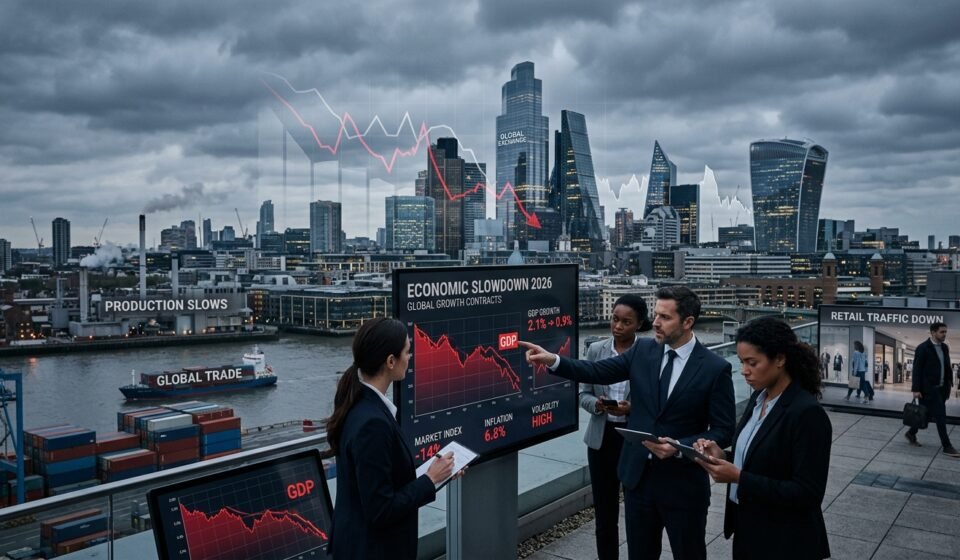

Economic Slowdown 2026 Warning Signs and Outlook – The global economy entered 2026 facing a complicated mix of opportunities and risks. While technological innovation, particularly in artificial intelligence, continues to support investment and productivity, concerns about slowing growth remain widespread. Policymakers, investors, and businesses are closely monitoring economic indicators for signs that the world economy could lose momentum.
The possibility of an Economic Slowdown 2026 has become a major topic of discussion due to persistent inflation pressures, geopolitical conflicts, high debt levels, trade uncertainty, and weaker consumer demand in several regions. Although most economists do not currently expect a severe global recession, many believe growth will remain below historical averages and uneven across countries.
Understanding the warning signs and outlook for the global economy can help businesses and investors prepare for potential challenges while identifying emerging opportunities.
What Is an Economic Slowdown?
An economic slowdown occurs when the rate of economic growth declines compared with previous periods.
Unlike a recession, which typically involves negative economic growth for multiple quarters, a slowdown simply means that economic activity is expanding more slowly than before.
During periods of slower growth, economies often experience:
- Reduced business investment
- Lower consumer spending
- Slower job creation
- Weaker industrial output
- Reduced international trade
An Economic Slowdown 2026 does not necessarily mean a global recession is imminent. However, slower growth can still affect financial markets, employment opportunities, and business performance.
Global Growth Is Expected to Moderate
Major international organizations continue to project positive global growth for 2026, but at a slower pace than many economies experienced in previous years.
The International Monetary Fund projects global growth of approximately 3.0% in 2026, below the average growth rates seen before the pandemic and slightly lower than recent years. The IMF notes that geopolitical tensions, energy market disruptions, and trade fragmentation continue to weigh on economic activity.
Similarly, the World Bank has warned that global growth remains constrained by policy uncertainty, trade tensions, and structural challenges affecting both advanced and developing economies.
These forecasts suggest that while growth continues, the pace of expansion may remain relatively modest.
Warning Sign 1: Persistent Inflation Pressures
One of the most important concerns surrounding the Economic Slowdown 2026 is inflation.
Although inflation rates have declined from their peak levels in many countries, progress has slowed considerably. The IMF recently noted that global disinflation has stalled, with headline inflation expected to remain elevated during 2026 before gradually easing.
Persistent inflation creates several challenges:
- Reduced purchasing power
- Higher business costs
- Lower consumer confidence
- Increased borrowing costs
- Pressure on household budgets
When consumers spend more on necessities such as food, energy, and housing, they often reduce discretionary spending, which can weaken overall economic activity.
Warning Sign 2: High Interest Rates
Central banks around the world have spent the past several years fighting inflation through tighter monetary policy.
Although some countries have started easing rates, borrowing costs remain relatively high compared with the years immediately following the pandemic.
Higher interest rates affect:
- Mortgage demand
- Consumer credit
- Corporate borrowing
- Real estate activity
- Business investment
When financing becomes more expensive, households and businesses often postpone major purchases and investments.
This reduction in spending can contribute to slower economic growth.
Warning Sign 3: Weak Consumer Spending
Consumer spending is one of the largest contributors to economic activity.
Recent economic data from several countries indicate that household spending is showing signs of weakness. For example, economists expect Thailand’s economic growth to slow significantly in 2026 due in part to weaker consumer demand, high household debt, and rising living costs. (Reuters)
Consumers in many countries continue to face:
- Higher housing costs
- Rising utility bills
- Expensive food prices
- Increased transportation expenses
As household budgets become stretched, spending on discretionary goods and services may decline.
A prolonged reduction in consumer demand could become a major driver of an Economic Slowdown 2026.
Warning Sign 4: Geopolitical Tensions
Geopolitical uncertainty remains one of the largest threats to the global economy.
The IMF has repeatedly highlighted risks associated with conflicts in the Middle East, disruptions to energy markets, and increasing geopolitical fragmentation.
Geopolitical tensions can affect economic growth through:
- Supply chain disruptions
- Higher commodity prices
- Reduced business confidence
- Increased market volatility
- Lower international investment
Businesses often delay expansion plans when uncertainty rises, reducing investment and economic activity.
Warning Sign 5: Energy Market Volatility
Energy prices continue to play a major role in the global outlook.
The IMF notes that energy market disruptions and conflict-related risks have contributed to higher inflation and uncertainty. Oil prices remain sensitive to geopolitical developments, particularly those involving major transportation routes and producing regions.
Higher energy prices can:
- Increase transportation costs
- Raise manufacturing expenses
- Reduce consumer spending power
- Contribute to inflation
Because energy affects nearly every sector of the economy, sustained price increases can significantly slow growth.
Warning Sign 6: Trade Fragmentation
International trade remains an important driver of global economic growth.
However, increasing trade restrictions, tariffs, and economic nationalism are creating challenges for businesses that depend on global supply chains.
The IMF warns that trade fragmentation could weaken output, increase prices, and reduce efficiency across the global economy.
Potential consequences include:
- Higher production costs
- Reduced export growth
- Lower business investment
- Slower productivity gains
As countries prioritize economic security and domestic production, global trade patterns may continue to shift.
Warning Sign 7: Rising Debt Levels
Debt remains a significant concern for both governments and private sectors.
Many countries accumulated large amounts of debt during recent economic crises.
Higher debt burdens create challenges because:
- Interest payments increase
- Fiscal flexibility declines
- Investment capacity becomes limited
- Financial vulnerabilities grow
Governments facing elevated debt levels may have less ability to support economic activity during future downturns.
The IMF continues to emphasize the importance of rebuilding fiscal space and maintaining sustainable public finances.
Why a Global Recession Is Not the Base Case
Despite these warning signs, most economists are not currently forecasting a severe global recession.
Several factors continue to support economic activity.
Strong Technology Investment
Artificial intelligence and digital infrastructure spending remain important growth drivers.
The IMF highlights an ongoing technology investment boom that is helping offset weakness in other sectors. Countries integrated into the AI value chain are experiencing stronger economic activity than many analysts expected.
Resilient Labor Markets
Many economies continue to maintain relatively healthy employment conditions.
Strong labor markets help support consumer spending and economic stability.
Expanding Emerging Markets
Many emerging economies continue to grow faster than advanced economies.
Population growth, urbanization, digital adoption, and infrastructure investment are supporting expansion across Asia, Africa, and parts of Latin America.
These factors reduce the likelihood of a synchronized global recession.
Regional Outlook for 2026
United States
The U.S. economy continues to benefit from technology investment and relatively strong consumer activity, although growth is expected to moderate compared with previous years.
Europe
Europe faces challenges related to energy costs, weak industrial activity, and slower consumer spending. Economic growth is expected to remain subdued.
China
China continues to play a crucial role in global growth, although structural challenges and trade tensions remain important factors influencing its outlook.
Emerging Markets
Many emerging economies continue to outperform developed markets due to favorable demographics, infrastructure development, and increasing domestic consumption.
What Investors Should Watch
Investors monitoring the Economic Slowdown 2026 should pay attention to several key indicators:
- Inflation trends
- Central bank decisions
- Consumer spending data
- Employment reports
- Manufacturing activity
- Global trade volumes
- Energy prices
- Business investment
Changes in these indicators often provide early signals about future economic performance.
Understanding these trends can help investors make more informed decisions in uncertain environments.
The Long-Term Outlook
Although growth may slow in 2026, long-term economic prospects remain supported by several structural trends.
Key growth drivers include:
- Artificial intelligence adoption
- Digital transformation
- Renewable energy investment
- Infrastructure development
- Expanding emerging markets
- Productivity improvements
These trends have the potential to support stronger growth beyond the current period of uncertainty.
The challenge for policymakers is balancing inflation control, financial stability, and economic expansion while navigating an increasingly complex global environment.
Conclusion
The Economic Slowdown 2026 remains a significant concern for businesses, investors, and policymakers worldwide. Persistent inflation, high interest rates, geopolitical tensions, trade fragmentation, energy market volatility, and elevated debt levels all represent important warning signs that could limit global growth.
However, the outlook is not entirely negative. Technology investment, artificial intelligence, resilient labor markets, and expanding emerging economies continue to provide support for economic activity. Current forecasts suggest slower growth rather than a severe global recession, although risks remain elevated.
As the global economy navigates these challenges, adaptability, innovation, and sound policy decisions will play critical roles in determining whether the slowdown remains manageable or develops into a more serious economic downturn.